GARETH.
Gareth McCorry // paintings, magnolias, music & two brothers trying to explain art.
Two brothers — one painter, one musician — talk about growing up, discovering music, making art, photography, blue skies, magnolia trees and what a painting might sound like.
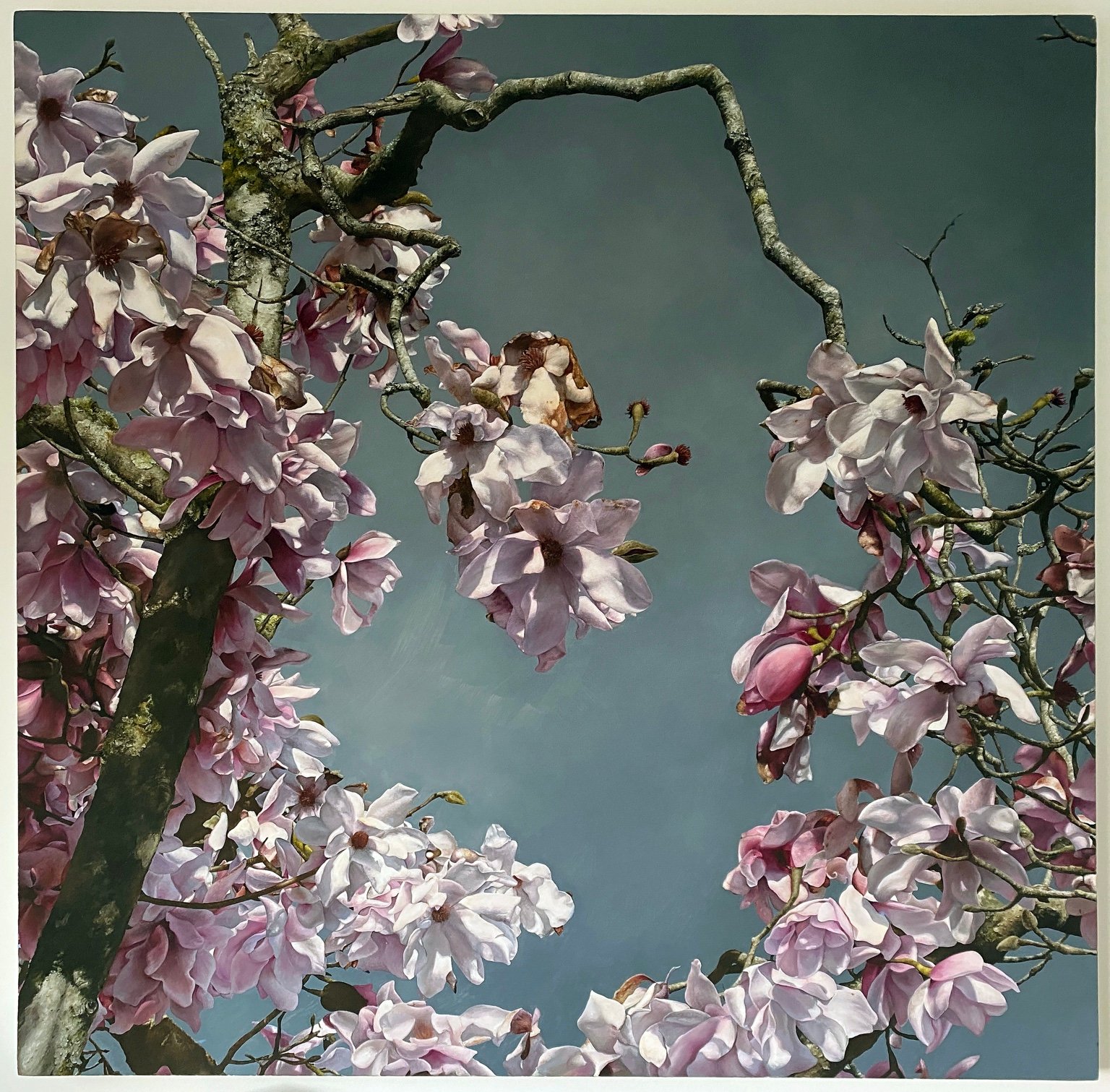
The conversation circles around a particular painting by Gareth: the magnolia artwork shown here, which Martin interpreted musically for his MA project.
TRANSCRIPT STATUS: MACHINE-GENERATED / NOT YET PROOFREAD. Names, places and speaker turns may be wrong. Corrections pending.
01 / LISTEN
02 / CONVERSATION MACHINE
Words emerge according to their original recording timestamps. Independent of the audio player.
03 / ONE PAINTING, TWO MEDIUMS
The original magnolia painting discussed in the interview. View the full photograph ↗
GENERATIVE FNP COMPOSITION
Martin McCorry · 2021 · 09:16
A generative musical interpretation of Gareth McCorry's magnolia painting, created for Martin's MA Final Negotiated Project. ONE PAINTING / TWO MEDIUMS / NINE MINUTES OF GENERATIVE
04 / SOMEWHERE IN THE CONVERSATION
Exploratory chapter markers from the uncorrected transcript. They jump to the closest timestamped passage; exact boundaries can be refined during proofreading.
04 / THE WORDS
Complete working Whisper transcription. No dialogue has been rewritten and no speaker names have been guessed. Timestamps are permanent links to passages on this page.
1544 transcript passages
00:00:03Hello, and welcome back to the podcast.
00:00:07I know it's been a little while between shows, but I've been really busy with school and life over the past month.
00:00:12I promise I'll be recording a bunch more very soon.
00:00:16This episode is a little different from the others, containing material I will use for a project of my own.
00:00:21In it, I interview the artist Gareth McCorry, who happens to be my brother, and also happens to be a part of this project.
00:00:29Together we hope to interpret one of his paintings as a piece of music.
00:00:33We discuss music, art and growing up.
00:00:36I hope you'd enjoy the discussion.
00:00:40In this interview we discuss a piece of Gareth's art.
00:00:43I'll put a video up on YouTube and put a link in the comments below so that you can see what we're talking about.
00:01:06Yeah, it should be sweet.
00:01:07No pressure at all.
00:01:10No pressure.
00:01:10It feels really weird.
00:01:12I know, it's mad, isn't it?
00:01:13But you can forget about it pretty soon.
00:01:15Yeah.
00:01:16Right, so I'm here talking to my brother.
00:01:18This is a slightly different episode of the podcast because it's one where I'm doing some more... Well, it's not, and it is because I'm doing some more work for uni, which this time doesn't necessarily...
00:01:30directly involve music.
00:01:32Well, it does, but it doesn't as well because I'm kind of doing a piece of artwork.
00:01:37When I say I, my brother's doing a piece of artwork and we are sort of going to interpret it as music using a computer program.
00:01:47So we're just going to talk a bit about...
00:01:49music and art for a bit and then we're going to figure out ways of making a painting from its abstract into a piece of music it's kind of like the ultimate graphical score so yeah um i'll just say hi to my brother hi bro hello okay so let's start off like
00:02:11We'll just chat about music first and how you, like your background in, because it's weird because like I started off, I think I mentioned it to you before, like as a kid I was always into art and you were always into music.
00:02:26Yeah.
00:02:26In bands and stuff and punk bands and that and then.
00:02:30mysteriously we kind of flipped and I became a musician and you became an artist but um but let's talk about music first like what what kind of what your earliest memories of music and what do you what kind of got you into music as such because I know it's an important part of your life um the first thing that got me into music properly
00:02:54Funnily enough, it was lyrics and it wasn't the music.
00:02:57When I heard the music, I was a little bit disappointed.
00:03:01Obviously, you know we've got an older sister, Lindsay, and she used to have Smash It's lyrics blue-tacked all over her bedroom wall and they were all kajagoogoo and stuff like that.
00:03:12I remember going in there one day and reading...
00:03:17the opening lines to Big Mouth Strikes again, you know, sweetness, I was only joking when I said I'd like to smash every tooth in your head.
00:03:24And sweetness, I was only joking when I said, by rights, you should be bludgeoned in your bed.
00:03:28And I thought, I'm into that.
00:03:30Whatever that is, I'm into that.
00:03:34And I remember the first time I heard The Smiths, thinking, oh, for fuck's sake, I'm into that.
00:03:38And it sounds horrible.
00:03:40I don't even like it.
00:03:42But then it grew on me, you know.
00:03:46And then from there, I was in this...
00:03:52When I left home, the three records I took with me were The World Won't Listen by The Smiths,
00:03:58Master of Puppets by Metallica and True Blue by Madonna.
00:04:03So it was quite an eclectic mix right from the beginning.
00:04:06I remember doing homework in the bedroom and you'd always, always have the musical choice.
00:04:12Largely because I didn't have any records or anything, but it would always be Guns N' Roses or The Smiths.
00:04:18Metallica or something, it would be like, oh, whilst we were doing homework.
00:04:21Yeah, I mean, early on.
00:04:24I mean, I suppose at the time I was probably about...
00:04:32I can't remember what year Crazy for You by Madonna came out.
00:04:35That was the first single I ever bought.
00:04:40But when I sort of got into music, it was like the Smiths, and then it was metal.
00:04:44I got into Metallica, and I think it was you who got me into Iron Maiden.
00:04:49You think you borrowed an Iron Maiden album off somebody?
00:04:51I think I watched that video, I know.
00:04:53Yeah, and funnily enough, it was the visual image off the Iron Maiden record that got me into it.
00:04:58I think it was that Live After Death where it's got that Eddie character breaking out of a grave with chains on his arms.
00:05:04I remember doing a rather poor pencil copy of it.
00:05:11But yeah, with music, obviously I liked the music.
00:05:17I liked listening to music.
00:05:19But the things that sort of led me into it were a lot more to do with the sort of visual aspects of it.
00:05:26And I was a big fan of John Cooper Clarke.
00:05:30And that had come from listening to that Snap, Crackle and Bop cassette in the car when Dad used to go to the pub and leave us out in the car.
00:05:40I know.
00:05:40Like people used to do back then.
00:05:42Yeah, it was standard practice, wasn't it?
00:05:44It was the 1970s, that's what you did.
00:05:46And we'd sit in the car and we'd be told, don't touch this tape player.
00:05:50And I think Dad had the Eagles' greatest hits.
00:05:53Yeah, witchy woman.
00:05:54Yeah, he had the greatest hits of the Eagles and John Cooper Clarke's Snap, Crackle and Bop.
00:05:59But I remember getting the book Ten Years in an Open-Ecked Shirt by John Cooper Clark from the library when I was about 11 and thinking, they're not having that back.
00:06:09I'm keeping this.
00:06:11And I did.
00:06:12That's shit.
00:06:16So, yeah, you know, words, the words were always important, lyrically.
00:06:22I mean, like, now to sort of jump ahead bloody 30-odd years, I'm not going to say that I'm going to say that I'm going to say that.
00:06:30The majority of the music I listen to now is Japanese because I find lyrics can really make or break a song for me.
00:06:39You know, one cheesy line here or there and it's like, oh, you've just ruined it and I can't listen to that song anymore.
00:06:46And I find that, you know, even though I've started learning Japanese, I have a certain hesitancy with learning the language because it's like, I don't want to know what a lot of these people are singing because...
00:06:59With the sort of music I'm listening to predominantly nowadays, the voice becomes more of an instrument within that sound range, whereas it never was for me before.
00:07:09I'd always be picking out what they said.
00:07:11Yeah, yeah.
00:07:12I remember you were always, like my, I suppose, and you're probably thinking back as well, you'll probably remember this, but my musical...
00:07:20Things that turn me on to music are fairly concrete in my mind and they're all based around a fairly young age, I'm guessing like seven or eight.
00:07:27I can't be exact, you might be able to tell us.
00:07:30And it was like Bobby Next Door.
00:07:32Yeah.
00:07:32I had like a clear thing with like six police records in and I remember you were always into like the fact that there was a radiator, a three-bar fire on the cover and, oh, look, it's melting the ice.
00:07:44Yeah, can't stand losing you.
00:07:46And we would just knock on the, like, we have a cord to knock on the wall, and it'd be like, if we knock on, like, three, you'd go three across and four down, and you'd play that record.
00:07:53It's like a pre-internet Spotify.
00:07:56Yeah, yeah, definitely.
00:07:57And I think, like, and then also, like, pretending to be an ACDC when we were going to do a gig.
00:08:03It was Kiss.
00:08:03Sorry, was it Kiss?
00:08:04It was Kiss, yeah.
00:08:05At the old people's home?
00:08:06Yeah.
00:08:07Why?
00:08:07I've no idea.
00:08:08But, like, these things kind of...
00:08:10I've seen the police videos I've seen the drama Bobby had learning difficulties and it was his idea of a good time we'll play down the old people's home yeah you know 20 year old man with two 8 year old children and we'll dress up as Kiss I know but that's sort of my early memories was like
00:08:27It kind of got me in like two sides of the coin.
00:08:29I still remember it all.
00:08:31Well, I rediscovered Kiss about five years ago.
00:08:35I bought a T-shirt.
00:08:35I saw a Kiss T-shirt and thought, and all these memories of Bobby's bedroom came flooding back.
00:08:42I was like, I've got to have that T-shirt.
00:08:44And then I thought, I knew Strutter and stuff like that and a few tracks.
00:08:50And I just sort of went back to early Kiss records and got...
00:08:54Went down that rabbit hole for a while.
00:08:56I tend to do that with music.
00:08:58I'll get into a band and I'll be like really into that band for 18 months to the point where I practically don't listen to anything else other than like one or two albums all the time.
00:09:07Yeah.
00:09:09And then I'll pick it up here and there in future.
00:09:12But, you know, I find it quite strange now when I look on social media and I see people from like our sort of...
00:09:19youth if you like up north and what have you um that are still listening to exactly the same records they were 25 30 year ago and they don't seem to have added any anything new to their sort of record collections or their musical tastes and that it's like
00:09:41I don't know.
00:09:42I remember reading an interview with John Peel years ago, and he said, I don't listen to anything old.
00:09:48And I thought, that's really weird.
00:09:50But I can kind of see where he's coming from.
00:09:54I do still go back to records, but there's certain records that I really love that really stand out to me.
00:10:00I think about it sometimes and think, oh God, I haven't listened to that for nearly 10 years.
00:10:03Yeah.
00:10:04But it's still as fresh in my head as it was.
00:10:06Yeah, I'm the same.
00:10:07I put it on and it kind of fills that need for another decade.
00:10:10Then I'm all right.
00:10:12Just listening to something else.
00:10:14Yeah.
00:10:14So I remember, obviously, you and your mates had always...
00:10:19I was kind of drawing pictures on the kitchen table and you and your mates were in the punk bands and stuff.
00:10:25Yeah.
00:10:25And you never really kind of grasped the art of playing anything.
00:10:28Was that because you'd come to be asked?
00:10:30I'd come to be asked.
00:10:31That was why, I mean, the last couple of bands I was in, I would just sang.
00:10:37I remember when I was in a band, Chocolate Fetus,
00:10:42And at first I was going to sing.
00:10:44No, I was going to play bass.
00:10:45I wanted to be Sid Vicious.
00:10:46I was going to play bass.
00:10:48And we had this like three note riff.
00:10:52And Cat lent me his bass guitar.
00:10:56And I took it back to my flat.
00:11:00I just couldn't fucking do it.
00:11:02I just, I was trying to try, I just, there's always been, there's always been that thing with music.
00:11:08I think that's one, maybe one of the reasons I started veering, oh, maybe it's not, it's not my veer towards painting, but one of the things that I always liked about painting was, it didn't matter if I got it wrong in the moment, I could go back, and do it again.
00:11:23Like,
00:11:24A lot of things like simple riffs, like the opening riff for, say, Pretty Vacant by the Sex Pistols.
00:11:31It's really easy.
00:11:32I can play it.
00:11:33But can I play it five times in a row without dropping a beat?
00:11:36No.
00:11:36My mind wanders off.
00:11:38I'm like, oh, shit, I'm not going to be doing that.
00:11:40And suddenly, you know.
00:11:41Forget where you are.
00:11:42Yeah, there's some things I can play on a guitar now that are fairly complex.
00:11:47But I didn't really start learning.
00:11:50And it'd be wrong to say I started learning guitar seriously because I never started learning guitar seriously.
00:11:59I decided to learn guitar after that horrendous mushroom trip that I had when I thought I was dead and I was in the bedroom with your guitar and I thought, I can't even play that guitar, this must be purgatory because it's not hell, it wasn't that bad, but it certainly wasn't heaven and the only thing in the room was a guitar that I couldn't play.
00:12:17And I remember next day saying, kids, you've got to show me how to play guitar.
00:12:21You showed me a few bits.
00:12:25I don't really know that much more than that even now on a guitar.
00:12:28I don't know either.
00:12:32Yeah, I could just never hold a tune and keep it going.
00:12:38But going back to the sort of punk bands and that.
00:12:44Yeah, I couldn't be arsed to learn an instrument.
00:12:47It just felt beyond me.
00:12:48It was too difficult, I thought.
00:12:51And if I sing, I've only got to carry a microphone.
00:12:54You know, leave it to other people to carry drums and instruments and do all the hard bits.
00:13:00Figure all that stuff out.
00:13:01I've loads of practices.
00:13:02Yeah, they can practice, do all the hard work, and I'll just rock up and get all the attention.
00:13:10Sounds about right.
00:13:12I remember being sort of...
00:13:15You know, you and all your mates were kind of into bands like Mattner and Cat and all them lot of them.
00:13:20And I'd be like... With Suggie and... Oh, we've got to try and do that now.
00:13:26Do you know what I mean?
00:13:27Starting crap punk bands and stuff.
00:13:28Yeah.
00:13:28Playing in Mattner's shed.
00:13:30Stuff like that.
00:13:32But I think you went beyond it fairly quickly because you were always practising.
00:13:36That was...
00:13:38I think that was a key difference with the music.
00:13:40And it's something that I eventually came to with painting, was that you'd practice because you loved it.
00:13:51You could see that you loved it.
00:13:52You loved doing it.
00:13:53You're quite happy to sit and practice.
00:13:55Whereas...
00:13:56For me, it was a means to an end.
00:13:58Yeah.
00:13:59It was like I'd have to practice because I want to be able to play guitar so that I can be in a band.
00:14:05You know, I think you quite enjoyed the process of just figuring it out.
00:14:09Yeah, I did.
00:14:10And I think as well, like, completely different than you, I had, like, lyrics just never really figured.
00:14:15No.
00:14:16They probably have more.
00:14:18over the years but it would start off i can't even remember half the lyrics in the song i was more interested in the songs and the riffs and the the feeling of the song you know like the vibe of it and stuff that's kind of where i the lyrics were kind of sometimes they were funny like the mach lads and stuff
00:14:32But more often than not, it was like, they were secondary, you know.
00:14:35To me, it was like the tune and the music and the sort of vibe of it, like the punkness of the Sex Pistols was kind of key rather than exactly what it was saying.
00:14:44It was like the attitude, if that makes sense.
00:14:45Yeah, yeah.
00:14:46I mean, the attitude in punk was always...
00:14:52I think that was the thing that got me with punk, you know, was that kind of attitude of I'll do what I want.
00:14:58And there's kind of a crossover as well with art, with the punk.
00:15:01Well, with a lot of music, there's a ton of crossover with art.
00:15:04With music, it's fairly standard over the years.
00:15:09I think with punk, it was a real...
00:15:11Even that kind of DIY, the covers were as important, the clothes were as important.
00:15:15Yeah.
00:15:16There's a music in a way, if not more.
00:15:19Yeah, a lot of the bands...
00:15:21that I was into the sort of later punk bands, I suppose, like from the 1980s, sort of mid-late 80s.
00:15:31It was a different scene by then.
00:15:33It was all very right on.
00:15:36But it retained that real DIY sort of ethos.
00:15:40I remember a band I used to meet called the Ardons, and the bass player used to draw.
00:15:46I think they were like, it might have been watercolours or like pencil crayons.
00:15:51But lots of these bands, they'd make their own artwork for the album covers.
00:15:58The gigs were all put on by...
00:16:01you know, just people that were just into the scene.
00:16:03Yeah, yeah.
00:16:04And they'd make the flyers themselves.
00:16:06And there was a...
00:16:08It did start to become a bit generic, the way these things were produced.
00:16:13They started to look...
00:16:14They had a certain look about them.
00:16:16Yeah, yeah, I remember.
00:16:19You know, and...
00:16:22It's funny, actually, because a lot of the people involved in that scene would be quite sneering and quite mocking of people that had that sort of 1970s punk look, spiky hair and leather jacket.
00:16:32Oh, God, man.
00:16:33But, and it's true of a lot of outsider groups.
00:16:38You know, they're like, God, look at all you sheep.
00:16:41They'll be within their own little group that's all got that...
00:16:45The exact same sport.
00:16:45Exact same identity.
00:16:47And I...
00:16:50You know, I don't know, maybe people would be able to point at me and say, no, you looked like one of them.
00:16:55But I always felt like I didn't quite fit in anyway, you know what I mean?
00:16:58Yeah.
00:16:59I remember friends of mine getting quite angry about the fact I had Madonna T-shirts and stuff.
00:17:05I think I was the same in bands.
00:17:07I played drums for that punk band, Criminal Damage.
00:17:11Yeah, I remember.
00:17:12And I was like the least punk-looking person ever.
00:17:14Yeah.
00:17:17and also bands like the Storm Roses with their Pollock sort of influence like John Squire was an artist to me personally I've kind of and I came from wanting to paint I suppose it was something I enjoyed and just totally stopped doing that was an in as well for me with music, the artwork the way it looked the ethos of you know
00:17:47John Squire painting them Jackson Pollock-esque kind of pictures and splattering it all over his guitars was kind of, wow, you know what I mean?
00:17:53The crossover between art and music was important for me.
00:17:56Probably became less so as I became more of a, more sort of focused on music, but I think to begin with it was really important.
00:18:05Like the Smiths covers with the photographs, everything kind of was, followed an aesthetic.
00:18:11Yeah, and I know exactly what you mean by that, you know, that...
00:18:16You know, I was sort of predominantly into music, but I was still into art.
00:18:20I used to do a lot of pencil drawings, and they'd usually be copies of, like, record covers, or I remember doing, copying the artwork from John Cribb Clark's book, Ten Years of an Open-Eight Shirt.
00:18:33I can't have been any older than eight or nine.
00:18:36and having that picture on the wall in fact we used it to cover the hole that we were drilling through to bobby's bedroom so we could tell him what music we wanted that didn't have to be in that um six by six code thing that we had but yeah and like you say i think as you get as you get older and you find your focus a bit more it falls away you know i i eventually
00:19:04Well, it's like I was saying earlier about playing guitar.
00:19:07You know, when I went to college to do art, I was as into playing guitar as I was into, like, visual art and creating visual art.
00:19:20I chose visual art because I thought it'd be easy.
00:19:24And I did, you know.
00:19:30But then I got into it.
00:19:34I got really into it.
00:19:35I mean, there was lots of things that steered me towards it.
00:19:42But one of the big things, and it was the same with music as well, was that rock and roll lifestyle thing.
00:19:47I remember reading about...
00:19:50people like Rossetti taking loads of opium and sleeping with all these models and thinking, that's the life for me.
00:19:57That's what I want to do.
00:19:58If I can't play guitar.
00:19:59Yeah, if I can't play guitar.
00:20:01And I'm a bit, I knew I couldn't sing, really.
00:20:05And I used to struggle with it.
00:20:08I can be quite vivacious and quite outgoing, but very much on my own terms.
00:20:13And there's certain times I can't deal with it.
00:20:17I couldn't, I always hated hearing my own voice come out of anything.
00:20:21Like, if I hear this, I might not even listen to this.
00:20:26I'm sorry.
00:20:26Yeah, I struggle with it.
00:20:29You know, and I used to feel like that with the bands and the music thing.
00:20:35They say, oh, it's all right if you fuck up on guitar because it's the guitar that makes the noise that sounds awful.
00:20:41Whereas if you drop a bum note while you're singing, that's come out of your mouth.
00:20:46That's part of you.
00:20:48The fuck up's my director.
00:20:51I didn't want to be associated with it.
00:20:53But yeah, I mean, that eventual sort of steering into a serious painting, because I got really serious about it for a long time.
00:21:01Probably too serious, really.
00:21:05was just finding that thing that really fascinated me, that I felt like I could keep unpicking forever.
00:21:14And what influenced you in terms of getting started with painting?
00:21:18Because I knew you were always, we used to sit around the kitchen table and draw on a Friday night.
00:21:23You know what I mean?
00:21:24Because what else to do?
00:21:26Do books and draw.
00:21:28Pictures are like Eddie from I Am Made and all.
00:21:30Yeah.
00:21:31You know, shit like that.
00:21:32But what kind of led you down?
00:21:35Yeah, I think what I sort of just, you know, by the time I'd left school, I was kind of working in that chemical lab and then I decided I just want to be in a band.
00:21:46It was more like sort of because of all you lot.
00:21:49And then I just sort of gravitated towards the problem solving of playing guitar and stuff.
00:21:55I really enjoyed it.
00:21:57Yeah.
00:21:58But you sort of then switched over to...
00:22:01Getting more focused on art.
00:22:02What inspired you in that sense?
00:22:07What kind of got the ball rolling for me, really, was just before I moved down here to Cornwall...
00:22:16Pardon me.
00:22:19I spent pretty much the best part of a year of my life essentially sitting on the sofa smoking bongs.
00:22:30People just coming and going.
00:22:33I started drawing cartoons for my friends.
00:22:36I always liked drawing.
00:22:39And then there was a guy, Simon, who went out with... Oh, yeah, a very good artist, wasn't he?
00:22:45Yeah, he had a certain style of art that...
00:22:50It reminded me a little of the artwork in John Cooper Clarke's books.
00:22:54And...
00:22:55I spent a little while kind of mimicking him a bit, his artwork.
00:23:00So I just thought it was really cool.
00:23:02And he was a couple of three years older.
00:23:04He was like...
00:23:05He'd been at art school or something.
00:23:06Yeah, and he had a really cool record collection.
00:23:08He had some cool paintings of Warhol.
00:23:10Yeah, yeah.
00:23:11Yeah, yeah.
00:23:11He'd done like...
00:23:13He'd done big work as well, you know, that was...
00:23:16you know, sort of three foot by three foot, which was massive to me.
00:23:20I'd never worked on anything bigger than A4 sheet of paper.
00:23:25Yeah, you know, I thought he seemed cool.
00:23:27I quite liked what he was doing.
00:23:30And then when I moved to Cornwall, I'd got, before I moved to Cornwall, I'd got really into looking at paintings in galleries.
00:23:42I got really into going to...
00:23:45But not... More museum type of galleries.
00:23:48It was old work that I was looking at.
00:23:50It was a lot of sort of Victoriana and Impressionist stuff.
00:23:57Stuff going back a bit older than that, but it wasn't really contemporary art that I was looking at.
00:24:03So that was a bit of a thing when I went to college and started finding out what contemporary art was.
00:24:10I mean, I knew of stuff like the abstract expressionists, I knew about pop art and whatever, but art had moved on from that even as well, you know, and that, even like the abstract expressionists and pop art to me felt a bit modern, a bit out there.
00:24:25Yeah, it still has got that modern feel, then you get kind of post-modern and modern.
00:24:29Yeah.
00:24:30Yeah, and...
00:24:34Yeah, I got into painting more when I moved to Cornwall.
00:24:38I didn't really know anybody, which was one of the reasons I wanted to move down here.
00:24:42I just didn't want to know anybody.
00:24:47and my girlfriend at the time bought me a set of paints.
00:24:51I think she bought them for me before I moved down.
00:24:53I started doing a bit of acrylic painting.
00:24:55And I'd had a year where I lived in Devon before I went back to, you know, ping-ponging around a bit and sort of moving around all over the place for a little while.
00:25:06And it was during that period I started painting more and more.
00:25:11And then, yeah, I came to Cornwall and...
00:25:16A lot of it was, I mean, I was painting a bit.
00:25:20And there was Birdie, who we lived with for a while.
00:25:22He was into painting.
00:25:24And me and Birdie both used to paint.
00:25:28I used to do some abstract expressionist paintings on the side of him.
00:25:31Yeah, I mean, we were for a bunch of sort of scuffers.
00:25:35We were fairly cultured.
00:25:36We were just punk scuffers.
00:25:37We were like sat around making art.
00:25:38Yeah.
00:25:41But I'd been painting a bit when I was living at the house with Birdie and you and what have you.
00:25:45And then, yeah, I came to court and I just carried it on.
00:25:49I carried it on and then... Because I remember that house where I stayed with you for a bit, up north, you'd started drawing semi-seriously.
00:25:58You were drawing, like, hands and you started honing on, like...
00:26:02like studies almost like you were doing like drawing studies as opposed to just drawing pictures I remember like vaguely because I was off and about doing a lot of music stuff but whenever I'd come back you'd seem to be focusing a little bit more on studies almost yeah I'd started I'd read some books I used to read an awful lot I don't read I don't read anywhere near as much as I used to I used to devour books and I'd read somewhere about you know
00:26:32understanding of anatomy being crucial for any artist, but obviously it's not crucial for any artist, it's crucial for a figurative artist.
00:26:41So it was like, okay, I've got to understand anatomy.
00:26:44And I was getting books on anatomy out of the library, like studying, like you said, studying the hands and different body parts, never fake because they're too weird.
00:26:56And I used to do quite a lot of eyes.
00:26:59And that's something that's a real trope if you go on Instagram, looking at art Instagram.
00:27:06Because you know how it is.
00:27:08Instagram's got different...
00:27:10Depending what you're into, you get a different kind of Instagram.
00:27:13Yeah, yeah, yeah.
00:27:14Some people's Instagrams are predominantly motorbikes and girls in bikinis.
00:27:19Some people's are predominantly music or memes or what have you.
00:27:24Mine's got a lot of art.
00:27:26It's probably why I don't look at it so much.
00:27:29And you get a lot of these single eye pictures where you do it quite detailed.
00:27:34And I used to do it.
00:27:36And half a face.
00:27:37Half a face is a classic.
00:27:39I used to do loads of half a faces.
00:27:40And basically it's because you can't get the other half to balance.
00:27:43So you just draw the one half really well and leave the other side mysterious.
00:27:49You can't be arsed to try and finish it off.
00:27:51But it was just struggling.
00:27:53And that was a real big thing with me with painting was when I started getting into it.
00:27:58I'm digressing slightly.
00:28:00I went to college.
00:28:03My girlfriend at the time came home from work one day and told me she was pregnant.
00:28:08And I just felt like my world had ended.
00:28:12It was just like, I thought, I can't even look after myself.
00:28:15I hadn't had a proper job for ages.
00:28:17I'd done bits of work, but...
00:28:19At that point, the longest I'd held down a job since, the first job I had when I'd left school, which I'd had for 18 months, had been about three weeks.
00:28:28And it'd been like, you know, best part of like seven or eight years like that, just dossing really, you know.
00:28:36Let's say doing bits of jobs here and there, enough to make some money here and there, but a lot of time just on the dole.
00:28:46I remember thinking, God, I can't even look after myself.
00:28:49I need, I've got, there's a child coming, there's another human being coming, I've got to look after it.
00:28:56I've got to get my shit together.
00:28:57So I thought, if I went to college, it'd...
00:29:03Give me something on my CV that would be recent that was like, look, you could stick at something for more than six months.
00:29:09And that might be just something to build on.
00:29:13And like I said, I went to college and I thought, I'll do art because I liked it.
00:29:18I was into painting and drawing.
00:29:20I was awful at it, to be completely frank.
00:29:23You know, I'd...
00:29:24I think I'd had a book on Moded Liani out of the library and I was sort of mixing, doing like a fusion of Moded Liani and the guy who did the illustrations for 10 years in an open neck shirt and Simon's work.
00:29:37It's just like all these big, boggly-eyed, skinny figures all elongated, sitting at coffee tables looking interesting.
00:29:45It's painful to look at some of them now.
00:29:49But, you know, we all do it.
00:29:51Fortunately, I didn't have to do it, you know, nobody was interested, so I didn't have to do it in public.
00:29:56And there's no Instagram.
00:29:57No, thank God, yeah.
00:29:58The fucking internet.
00:30:00Oh, no.
00:30:00I'd have flooded it with it as well, you know, honest to God.
00:30:04But, yeah, so I went to college, and I went and did art at college.
00:30:12You know, because I was thinking I'd maybe get into graphic design or something like that.
00:30:15I thought I might fancy that.
00:30:17Yeah, yeah.
00:30:17Because you did a lot of photography as well, didn't you, for a bit?
00:30:19Yeah, I went right up until the end of university, in my last couple of years at university.
00:30:26Because I went on to university from college.
00:30:29which was a real leap for me at the time because I just didn't think people like me went to university.
00:30:34It's like, you know, I don't know, it seemed like something for other Oxbridge types or what have you.
00:30:40They did that.
00:30:41Did anyone from our school go to university?
00:30:44I don't know.
00:30:46I think I did straight after school, you know what I mean, binned it off, but most people just didn't do it, did they?
00:30:51No, no, it wasn't...
00:30:51It wasn't like a normal thing.
00:30:54No.
00:30:55No, I mean, I think I was saying to you the other day, it's like that Mickey Flanagan joke about his mate at school saying he wants to drive a truck and him and his mates go, no, we don't drive trucks, we put things on the truck.
00:31:08You know, and it was, the school we went to was that real low aspiration kind of... Shite.
00:31:14Yeah, it was like...
00:31:18You know, the best way to succeed at that school was by being the biggest tool you could possibly be.
00:31:25Injecting yourself in acid, attacking the headmistress or something.
00:31:29So I'd gone to college and they'd suggested that I go on to university.
00:31:35And at the time I thought, well, obviously Cameron had been born by them, the oldest lad.
00:31:40And I was thinking, yeah, I still haven't got a clue.
00:31:43Maybe I'll buy myself another couple of years and go to university then.
00:31:47So I did.
00:31:48It wasn't...
00:31:52I knew by that point I certainly didn't want to do sculpture.
00:31:56Three-dimensional arts had gone out the window.
00:31:59But it wasn't right up until the final two years at university when they made me specialise.
00:32:06that I dropped printmaking and photography.
00:32:09And I've always kept that photographic element in my work.
00:32:12I did a lot of photography associated with my work.
00:32:16And then again, the reason I ultimately chose painting at that stage was I thought, well, I'm going to leave university at some point.
00:32:24And I still had in mind where I'll probably end up back on the dole and doing nothing.
00:32:34And at that point, digital photography was just coming in.
00:32:37It was like, well, I ain't got a dark room.
00:32:42The other things required equipment that painting doesn't.
00:32:46You just need some paints, a few brushes and a space, a table, and you can do it.
00:32:53But I think painting was my first love.
00:32:54It was what had taken me into college and university.
00:33:01to study art and then there was all these different possibilities opened up with, you know, like say understanding a lot of sort of more postmodern art and you know, there was, it was the very end of the nineties that I went to college.
00:33:15So it was all that YBA stuff that was very big, you know, Damien Hirst and James Yehman and all that lot.
00:33:22which didn't really float my boat.
00:33:24I liked Glenn Brown's work.
00:33:26I thought I really liked Glenn Brown's work.
00:33:29But other than that, there weren't a lot of it that really floated my boat.
00:33:34I liked Gerhard Richter, German painter Gerhard Richter.
00:33:37He's really well known in painting.
00:33:42But there weren't many artists that I liked.
00:33:43I liked a lot of older stuff.
00:33:48I mean, to digress and go right back again, a weekend that was really pivotal for me with finding art and finding painting was...
00:34:03Dad was doing an Open University degree.
00:34:05Yeah, I was going to bring this up.
00:34:07Yeah, and he took us to Manchester Art Gallery.
00:34:09Was it the Whitworth or something like that?
00:34:11No, it was the City Art Gallery in Manchester because it's the one that's got a star, Sirisia by Dante Gaviria, and it's got Waterhouse's Hiles and the Nymphs.
00:34:22Has it got a failure in it or am I imagining something?
00:34:24I don't know.
00:34:25Ophelia oh the one like the woman in the lake thing no that's in I think that's in the Tate in London I've seen that one but yeah that kind of stuff yeah but that's that's a Millais I remember going there yeah that's a Millais painting it's got a couple of Millais paintings in there it's got some Stanhope Forbes work but the one that really grabbed me was
00:34:47I started Rosetti's portrait of Jane Morris in the green dress with the torchbearers behind her and I just I remember being blown away by that and then getting into art through books then primarily you know I mean don't want to go off on that whole Walter Benjamin art in the age of mechanical reproduction tangent but I was
00:35:11to use the word consume, I was consuming art primarily, especially when I moved to Cornwall, because I'd been to the Tate Gallery in St Ives, and I thought I hated it, I thought it was shit, and put it down to me being stupid, I thought, oh, you're just stupid, you don't understand this stuff, that's why it's shit, because you're an idiot, as it was.
00:35:33Been away, studied art for years, got a degree, practised it for 10 years plus and I still think it's shit.
00:35:39So, you know, I think it's just a subjective taste.
00:35:43Yeah, yeah.
00:35:44But yeah, I was really into that pre-Raphaelite art, but it always seemed to be a bit of a barrier to me.
00:35:50It's like, you couldn't paint like that.
00:35:53Yeah.
00:35:53You can't paint that well.
00:35:54I was hiding behind abstraction for a long time, using it as like...
00:36:00If work's semi-abstract, you can always say it's meant to look like that.
00:36:05Yeah, yeah.
00:36:05Nobody can say it's different.
00:36:07Because that was the intention.
00:36:09Yeah.
00:36:10And I did hide behind that for a long time.
00:36:12But, I mean, obviously you know my work.
00:36:14There's a couple of pieces here in front of us and what have you.
00:36:19And it's very realistic.
00:36:21But I often get...
00:36:24tagged with that photorealist thing.
00:36:27Yeah, which it isn't.
00:36:27I don't like it.
00:36:28Because to me, it comes more from that sort of pre-Raphaelite tradition.
00:36:33But in a way...
00:36:37It went back to the early Northern European Renaissance work that had inspired them, the work pre-Raphael.
00:36:48Is that the Dutch Masters and stuff?
00:36:49Yeah, Van Eyck, Van Gogh, all your vans and very rigid-looking figures, tiny detail, glaze upon glaze upon glaze to build the colour up.
00:37:02I loved a lot of that.
00:37:06Yeah, and the pre-Raphaelite thing was, you know, in my work.
00:37:10Once I'd left university and started establishing a proper art practice for myself, obviously got a lot of time, I had a lot of time standing in front of canvases.
00:37:26Obviously it was linen, but I still refer to them as canvases.
00:37:31I don't really know why I use linen.
00:37:32I just think it looks nice on the little tag oil on linen.
00:37:36It doesn't really matter how much difference it makes.
00:37:38You put so much primer on it, there's no texture anyway.
00:37:41Arguably, they'd be better on panel or board because they'd be a bit sturdier.
00:37:46But I spent a lot, a lot of time in front of canvas painting thinking, what is this all about?
00:37:55What am I getting out of here?
00:37:56What am I driving out of here?
00:37:58It's not.
00:38:00it's not just an actor sort of slavishly copying a photograph.
00:38:04It's...
00:38:06It's compositional, isn't it, as well?
00:38:08It's compositional, but... As well as going to...
00:38:14There's a thing in Bruce Lee's book, The Tao Jeet Kune Do, where he says that when you first start learning martial arts, a punch is just a punch, a kick's just a kick.
00:38:26And then you realise that there's so much more to a punch and there's so much more to a kick.
00:38:31And you practise and you practise and then you realise that a punch is just a punch and a kick's just a kick.
00:38:35Yeah.
00:38:37It was like I went through university and it took so many different influences.
00:38:42And I see it all in my work.
00:38:44It's where my hackles go when everyone goes, oh, it looks just like a photograph or whatever.
00:38:49I'm thinking, but I can't expect anybody to see all that.
00:38:53I can't see my influences in it.
00:38:57People like Velasquez, I love his brushwork.
00:39:00There's echoes of it in mine, but it's just on a really tiny scale.
00:39:05You've got to get your nose right up to the canvas to see that tiny scale of it.
00:39:09But I'd say the predominant influence in it that you can see more, or I believe you can see more, is that pre-Raphaelite thing.
00:39:21But without the figures, that's where the titles came in with a lot of my work, which were often lines from songs.
00:39:31Always lines from songs.
00:39:32There's always a musical crossover.
00:39:34Yeah, definitely.
00:39:37I'd have these sort of lines from songs, usually romantic kind of...
00:39:45familiar things that were descriptive of familiar emotions that anybody could have felt like and i found that i fucking hate the word juxtaposition um it's not academic i don't know i'd never heard it until contemporaneously i'd never heard it until i went to college and um i think it was within the first week my tutor said oh this is what juxtaposition means and within a month i was thinking i'm sick of hearing that fucking word
00:40:17but coupling the song titles with the images it's funny how it changes it, it gives it a certain feeling which isn't there in the image it's there in you
00:40:35And as I got older, I used to be really enamoured by Rosetti's affair with Jane Morris and what have you as an example.
00:40:43And the whole thing with Lizzie Siddall and all that.
00:40:46It was all beautifully tragic.
00:40:49And then I got older and I remember getting quite judgmental.
00:40:55It's ridiculous.
00:40:57Thinking, that was your mate's wife, you cunt.
00:41:00You know?
00:41:01So I started, like, disliking him for it and I started finding... Because when I first...
00:41:09When I started going to college, all my paintings were of people.
00:41:12I abstracted people a lot of the time, but it was always people.
00:41:15People, people, people.
00:41:16Yeah, I remember your college, like, show and stuff and it was the opposite of what it is now, where it was all people and the odd.
00:41:23Yeah.
00:41:23A pointer to what you do now.
00:41:25I think at risk of getting cancelled, I wanted girls to set the clothes off for me.
00:41:30You know, so if I do nudes as well, that'd be a yes, you know.
00:41:36But it never panned out.
00:41:37I don't think I've ever asked a girl to pose nude for me, so, you know, don't cancel my non-existent Twitter account.
00:41:44I, erm...
00:41:47Almost immediately, I was into the painting for the sake of the painting and the idea of having somebody in the room would just be a massive distraction.
00:41:55But I took the figures out of the paintings completely.
00:41:58I didn't want the figures in there.
00:42:00You know, I suppose it would be a more pretentious, hearty bit.
00:42:08was the idea that the viewer had become the protagonist in that narrative themselves.
00:42:14They kind of replaced the figure in the painting.
00:42:16Yeah, yeah.
00:42:16You know, you put your own emotional feelings into it.
00:42:18You put your own slant on it.
00:42:21Did you do a Cajun sort of painting of a blue sky one time?
00:42:24I did.
00:42:25Oh, God, I got so...
00:42:26I did an exhibition and it got so...
00:42:29It was the only painting that got real hate in the...
00:42:33It's called I Remember You.
00:42:34And it was a blue sky.
00:42:35It was just a blue sky.
00:42:36I did a few of them.
00:42:38The gallery wouldn't take them, but we were like, we can't take that, it's just a blue... And it wasn't just a blue fucking square, there was like a...
00:42:45Subtle.
00:42:46It was really subtle, but if you isolated, say, the top left-hand corner of it and the bottom right-hand corner, the difference in the blues was incredible.
00:42:58It was a quite dramatic shift, but it was over a big canvas and it was subtle and there was this...
00:43:07I felt like I had a proper feeling of sort of water vapour cloud on there like you get when you look up into the blue sky on a sunny day.
00:43:16And I loved those paintings and I really valued those paintings.
00:43:21And it was a bit of a kick in the dick that everybody seemed to hate them.
00:43:28Oh, well.
00:43:31I think that was like a logical extension of like the furthest point in your work in a way, wasn't it?
00:43:36Yeah, it was.
00:43:39Because I went on... At the end of university, I really sort of wanted to throw out all the academic stuff.
00:43:48I'd just had enough.
00:43:50I'm fed up.
00:43:53Yeah, analysing your work.
00:43:57Yeah.
00:43:58And it seemed as well, on the degree that I was doing, there was a lot of people that weren't really into art.
00:44:08To be frank about it, there was a lot of people that weren't into art that wanted a cheap degree so they could learn to teach, so they could get a teacher training thing and then get a career as a teacher.
00:44:18And...
00:44:21If they could get the academic bit down, it didn't matter if the work was dog shit.
00:44:25It just didn't matter at all.
00:44:26It didn't matter if they were never in the studio working or anything like that.
00:44:29And I was...
00:44:30When I was at university, I was in my studio, like, first thing in the morning and there all day working, just painting, painting, painting.
00:44:37But I was working on big, complex pieces that required you to be there all day.
00:44:41And then somebody else would come in and they'd be quite open about it when the tutors weren't around.
00:44:47They'd, like, just sort of chuck some paint at a canvas and say, oh, I've just got to go away and think up some arty wank to go with that now.
00:44:54And then grading time would come around.
00:44:56They'd have a mark as good as mine and I'd feel really cheated.
00:44:59You know?
00:45:01But, and I just...
00:45:05Nobody was interested in what it looked like.
00:45:09It was always just what it was all about.
00:45:11And I felt both matters.
00:45:15Yeah, I think so as well.
00:45:18There was an essay I read by a guy called Dave Hickey called...
00:45:25I think it's called Enter the Dragon on the vernacular of beauty.
00:45:29It's part of his Invisible Dragon essays on beauty.
00:45:32And he was the first person I'd heard that brought beauty back into it as a relevant thing.
00:45:39And I thought, I'm going to go completely the other way.
00:45:42It's a bit of that punk thing again.
00:45:45It was like, right, what can I do that's sort of two fingers up to all this stuff going on here?
00:45:52And...
00:45:53I thought, paint something beautiful as well as you possibly can.
00:45:57Nobody's doing that.
00:45:58Everybody's doing edgy.
00:46:01Everyone's trying to be edgy.
00:46:04And yeah, sure enough, my tutors hated it.
00:46:09But I enjoyed it.
00:46:11And the reaction to my work at the end of year show and what have you was...
00:46:16It was really positive.
00:46:18It was quite shocking that it seemed like a lot of these people that were students and a lot of staff as well at the university.
00:46:30I'd rented the...
00:46:33I didn't rent it out.
00:46:34I booked the...
00:46:37big foyer area at the university out because you used to be able to book it out for like exhibitions and I'd booked it out it was meant to be during the holidays so I could just photograph my work in a big space um and as it was I think they'd been a cock up and I ended up having to have it the week I think it might be the week we came back or the week before I can't remember for
00:47:01but yeah the comments it was really flattering, it was really something that so many people and a lot of it was like staff at the university as well people like cleaners and that saying I've been here 20 years, I've never seen anything like this this is brilliant and I felt as well that
00:47:24I had more of an affinity with those people.
00:47:27I remember talking to one of my tutors about it, saying that I wanted to produce art that had an appeal to people like me.
00:47:38I wanted to produce the art that wasn't in art galleries when I went in, that I wanted to see.
00:47:43And I remember talking to him about wanting...
00:47:50Yeah, art for people that were less academic and might not necessarily understand all this work.
00:47:59Might not want to have it explained to them.
00:48:01It was like, this is a piece of art.
00:48:03And he said to me, and at the time it grated with me, but he was absolutely right.
00:48:07People at art don't go in art galleries.
00:48:11I was thinking yes but I'm going to make them they're going to come to art galleries to see my work especially to see my stuff but nah sure enough so the painting in front of me is a a huge magnolia and I've seen quite a lot of your work is magnolias not all of it some of my favourites are trees as well but where did the magnolias come in was it just you liked them no it was I mean I did like them obviously you
00:48:41Like I said, I'd got into this idea of painting beautiful things.
00:48:45And Magnolia's a...
00:48:49unashamedly beautiful trees you know when they're in full flower they're so blousy they're so like pink and almost gaudy yeah you know and I had been playing around a little bit towards the end of university with certain kitsch things and whatever but then I felt like yeah I remember them kitsch things were ace yeah but then I felt like that was just trying a bit too hard as well you know I kind of there's a little element of the sort of Damien Hurstiness to it as well that kind of you know
00:49:14It was like the cool, it was almost too cool.
00:49:18It's like Wicked Elvie's sort of miniature stature as blah, blah.
00:49:22Yeah, yeah.
00:49:23Yeah, I mean, I enjoyed them.
00:49:25Yeah.
00:49:25And that nativity thing I enjoyed, you know, but I think, and my tutors were lapping all that stuff up because it had this kind of academic bent to it, you know, and it had, and it was subverting the genre a bit and all that.
00:49:39But then I just, yeah, I wanted to, I didn't want to try so hard with it.
00:49:43I don't get it wrong, I was trying really hard with the painting, but I just, I kind of wanted to let it evolve in its own way.
00:49:51And I came back to Cornwall, because I'd gone away for three years to do my degree.
00:49:57And I came back to Cornwall and I couldn't help but notice the magnolia trees.
00:50:03There's a gardens up in Haymoor called Trengwenton.
00:50:08I've probably pronounced that wrong.
00:50:12But they've got, like, some of the sort of finest magnolias in the world up there.
00:50:20And if you go up there in spring, it is absolutely out of this world.
00:50:24It's, you know, it's mind-blowing.
00:50:26And we used to go up there with my ex-wife's parents, like, walking.
00:50:31And I was always looking for paintings.
00:50:34I always had my camera with me.
00:50:37Never used to take pictures of my family.
00:50:38I'd just be taking pictures of paintings all the time.
00:50:42Awful, awful, awful man.
00:50:47And yeah, I just got into the Magnolias.
00:50:49There was something about the way they break the sky, though.
00:50:53You know, and going back to what I was saying about different contemporary influences and what have you, Mondrian, it reminded me a bit of Mondrian's work.
00:51:02Yeah.
00:51:02You know, and the way the lines broke the sky reminded me of the way his black lines broke the...
00:51:10differing white backgrounds I mean that was one of his things the whites are always different in between I really like his sort of mid and early stuff with them trees and then the ones that are just white or variants of grey I really like I mean his later ones are astounding but I think I kind of really like his middle work same here like you say in his early work where he was you can see how he got you can totally see how he got to where he was getting to it's like the sort of you know
00:51:39Yeah, he's almost like parodying himself every time and reaching that point.
00:51:44Yeah, it's like with Pollock as well.
00:51:45I think you see that in his work.
00:51:47If you look at his early work, it's...
00:51:49The lines are formed.
00:51:51They're painted as brush strokes or as pen strokes or what have you.
00:51:55And then he gets to that later work where he's forming the lines by flinging the paint, you know.
00:52:00Yeah.
00:52:01I think it might have been him that said or somebody else that said it about him that he throws it like a lasso, throws it like a rope, you know.
00:52:09You play a bit on that cowboy image of him.
00:52:11Yeah.
00:52:14But.
00:52:17Yeah, so the Magnolias, they were just there and they were... And they do kind of have a sort of abstract Pollockness to them as well, don't they?
00:52:26Yeah, I like the chaotic nature of some of the compositions that I could get with them.
00:52:31I mean, the first Magnolia painting I did was a big single bloom.
00:52:35It was a four foot by four foot canvas, if I remember right.
00:52:43I'm not going to go off on a tangent about that.
00:52:48No, well, the woman that bought it rang me up a few years ago asking what I thought it'd be worth.
00:52:53And I told her I'd give her 40 quid for it.
00:52:56I said, it's worth a stretch.
00:52:57She said, mate, I've done it.
00:52:58I'm done with it.
00:52:59I just put out that she bought it as an investment.
00:53:02Yeah.
00:53:04Who cares what it's worth?
00:53:05Do you like it?
00:53:06Yeah.
00:53:07You know?
00:53:08But, yeah, so...
00:53:11Because I'd started, the first sort of floral paintings I'd done were big pop art type of things.
00:53:19So, you know, the flower on it was about three and a half foot across.
00:53:23It was like this gigantic... Rose or something?
00:53:26Flower, yeah.
00:53:27Well, the first one I'd done was... What was it you did first?
00:53:30Yeah, I did the big rose first.
00:53:32Then I did two or three red roses.
00:53:35I did an iris.
00:53:37um and handful of them less less than 10 um big individual flower paintings probably about seven um and then i did a magnolia which is smaller breaking you know and it was about the composition i'd used it to
00:53:59almost split the canvas along the diagonal.
00:54:02So you had one half of the canvas along the diagonal to the right that was blue, just the blue of the sky.
00:54:09And then the other, it was a slight curve to the diagonal, but it balanced the composition.
00:54:14And it's broken, essentially black and grey lines and pink.
00:54:21But that was on a much smaller scale.
00:54:24I mean, the more recent Magnolias that I did.
00:54:29And again, there's not loads of them.
00:54:31It's funny, you know, because of the sort of labour-intensive nature of my work.
00:54:36I don't think I've done more than 20 Magnolia paintings.
00:54:40Yeah.
00:54:42But the later ones, which...
00:54:49They were very different from one another, but...
00:54:53I did one called Stop Me If You Think You've Heard This One Before because I started to feel like they were getting a bit samey.
00:54:59But even though they genuinely weren't, if you look at the compositions, they're nothing like one another.
00:55:04But I reached it...
00:55:10I can't remember exactly when it was.
00:55:11Probably around about 2005.
00:55:15I started painting everything on a one-to-one scale.
00:55:21Yeah, I've noticed as well, but you're...
00:55:23You seem to, for a while, zoom right out.
00:55:26Yeah.
00:55:27Like, in your perspective, you've kind of zoomed really far out.
00:55:30It's like massive landscapes at one point, from, like, being really in.
00:55:34Yeah.
00:55:34You've zoomed all the way out, and then you've kind of refocused back to sort of 50mm lens land.
00:55:39Yeah, I've mixed the...
00:55:41I sort of mixed the two a bit now.
00:55:43I mean, I say I've mixed the two a bit now.
00:55:45At the minute, I'm not painting.
00:55:46I haven't painted for nearly well over a year.
00:55:51I know I'm coming back to it at some point.
00:55:53I just, I think I just needed a break.
00:55:55Yeah, yeah.
00:55:56You know, I'd... You've done most of your life.
00:55:59I've done it, yeah.
00:56:00I had done it most of my life.
00:56:01And, you know, I was not going to go into it all now, but I had quite a few problems, like, in my private life and my personal life and, like, mental health issues, for want of a better term.
00:56:17And it got to a point where me spending all day every day in a room on my own wasn't a good idea anymore.
00:56:23It's like focusing on a three-inch patch of 15 hours.
00:56:29Yeah, so at the minute I spend more time building and really enjoy it.
00:56:38paintings always in the back of my mind you know it's like you know it's like a dodgy x you know if you go back to it's going to be a fucking disaster but you just know you're going back to it oh god why am i doing that so but yeah like going back to what you're saying about zooming in and zooming out
00:57:04The sort of later work that I was producing was a mix of the two.
00:57:11It was...
00:57:14I got into cherry blossoms.
00:57:16I was going down that little rabbit hole.
00:57:19Cherry blossoms and magnolias at a one-to-one scale in these big, wide landscapes with... Like we were saying about taking the people out, I took everything out.
00:57:30I'd take out buildings and stuff like that.
00:57:32So there's no...
00:57:33It takes a while to notice.
00:57:35If you look at one of my big panoramic landscapes...
00:57:39kind of nice and soothing and then after a bit it's maybe it done for other people maybe it just did for me because i was spending months and months in the tiny bro but it was all a bit the day the earth stood still it was all a little bit weird no life where is everybody and then you know the idea of there being a figure in that landscape suddenly it could be quite threatening because you know you
00:58:04where do you go for help there's no roads all the roads have gone there's no there's no buildings there's no anybody anywhere you know and but yeah and then sort of mixed with that with the magnolias and the cherry blossoms which we're always looking up through the sky um at a one-to-one scale so it'd be the size it'd be if you were right in front of that thing so it just kind of feels you
00:58:34It doesn't feel real because it's a painting.
00:58:36Yeah.
00:58:37But...
00:58:40It's an illusion of reality.
00:58:41Yeah.
00:58:43But then just before... Because I jacked it all in about... Well, I mean, you know all this, but I suppose for the benefit of anybody listening, I jacked it all in about ten years ago.
00:58:56I didn't paint at all for about 18 months and two years.
00:59:02Just my head went, it went completely.
00:59:05But the work I was working on then, I remember talking to you about it at the time and saying you could kind of see my breakdown happening because I'd gone from these like...
00:59:17landscapes and the magnolias and what have you always had blue skies behind them they're always blue and pretty i've done one with a gray sky but it was quite a light gray sky it was called waiting for your breath which is a reference to last caress by misfits which is just you know waiting for your breath sounds so lovely yeah it's like it's romantic and touching it's a misfit song yeah it's quite uh it's a fucking dark song as well you
00:59:44But that would go over just about anybody's head, you know.
00:59:48But anyway, the magnolias and the cherry blossoms always had blue skies.
00:59:52They were always kind of pretty.
00:59:56And then, I mean, none of this work got exhibited.
01:00:00I was working towards this big sort of solo show up in Bath at a really good gallery.
01:00:06And I ended up, like, burning most at work and everything.
01:00:10But the work I'd started working on for it was...
01:00:14like still lives.
01:00:15And I'd started spending a lot of time just in my studio.
01:00:19Things were shit.
01:00:20I didn't want to go home.
01:00:21I was, you know, and, and it was reflected in the paintings.
01:00:26They're all like sort of dying bouquets of flowers and what have you on.
01:00:31the windowsills and whatever, you know, studio or hanging off a nail, you know.
01:00:37Well, PZ2 screw, to be precise.
01:00:45But it'd all come in and they weren't monochrome, but they had a real monochrome thing about them where there was very little colour.
01:00:54There might be a little bit of, say, pink in a sweet pea or...
01:00:58I did white roses that were tied together with red cotton.
01:01:02Yeah, yeah.
01:01:03Painting cotton.
01:01:04Like, you know, making sure I got the shadows right on it and the feeling of, like, the texture of the cotton noise.
01:01:11It's not right.
01:01:12It's not right at all.
01:01:14But...
01:01:15I don't regret burning that work or smashing a load of it up and throwing it away and what have you, but it would have been nice to see some of it through, to resolve some of it.
01:01:25I mean, there's one here that obviously you can see, which... Yeah, I'll put some images up somewhere, or I'll probably do a little video on it and put it up somewhere so people can see the work.
01:01:35Well, that's a work in progress, and, you know, that epitomises that work.
01:01:42I feel like if I get that painting finished and finish it well...
01:01:45There's one that a guy in Germany's got who's collected my work for years.
01:01:50He's ace.
01:01:52Hello, Kay, if you're listening.
01:01:57He's got one of two white roses hanging on the screw in my studio.
01:02:03And between that and the sweet pea one there on the windowsill, I feel like that sort of encapsulates that work.
01:02:09And that's all I need to do to...
01:02:13have a sense of closure with that work, like, artwork's done.
01:02:17You know, I don't need ten paintings of it, but because the studio was painted white and they're against the walls or the windowsill, and on that one there, there's colour outside the window, but it's quite bleached out.
01:02:28Yeah, yeah.
01:02:29Windows were dirty and what have you.
01:02:32So, yeah, they were all quite grey and dark.
01:02:36It had gone from these open... Yeah, they'd come really zoomed in.
01:02:39...kind of scenes to zoomed in and indoors and closed in.
01:02:43It was... Yeah, it wasn't... Because that's like the nature of things have become trapped.
01:02:48Yeah, and it hadn't...
01:02:50In your studio, a bit like yourself.
01:02:52Yeah, and I felt, you know, to be honest, I felt a bit trapped by my own painting process as well.
01:02:58It was a bit like, where do you go with this now?
01:03:01You know... You know...
01:03:04yeah, fuck it, I'll have an ego the size of Africa and compare myself to Jackson Pollock.
01:03:09But I remember looking at Pollock's work, and like I was saying earlier, you can see him trying to find his way to this particular... And then he gets it.
01:03:20And, you know, there's a lot of art myths around about people and Pollock's seen as this painter pissed out of his head and all that.
01:03:27Yeah, aggressive and blah, blah.
01:03:29Yeah, but his best work, he was sober.
01:03:31He wasn't drinking.
01:03:32He drank.
01:03:34It was like he drank and drank and drank and then once he hit this style of painting, got where he wanted to, figured out what he was trying to do and how to actually produce what he wanted, he produced his best work sober.
01:03:46But I think...
01:03:48I don't know, I'm not in the guy's, I was never in the guy's header or what, but it seemed to me like he kind of got there and it's like, you know, and he did different things with it, but...
01:04:00there's a finite nature to that.
01:04:02It's like, well, where'd you go from here?
01:04:04And his later work, he started drinking again.
01:04:06They started cutting shapes out of it and stuff like that.
01:04:08And none of that really worked.
01:04:11You know what I mean?
01:04:11His best work by far is from that period when he was doing, you know, the drip paintings, autumn rhythm.
01:04:18I really like the deep.
01:04:20Yeah.
01:04:20The deep's fantastic.
01:04:22There was a... Funnily enough, I kind of had that in mind with that painting there.
01:04:27It kind of echoes of the deep in a space, doesn't it?
01:04:30I've got a little photograph somewhere of a sycamore tree, which I wanted to paint, which maybe I will do one day, which always reminded me of the deep, but it's like in negative, so the dark, where the corner's dark in Pollux, it's bright where the sun's coming through, and then the leaves create this...
01:04:49But it's got a certain depth about it, but the other way around.
01:04:54But yeah, going back to what I was saying about... Not just about Pollock, about achieving something.
01:05:03Yeah.
01:05:03Being really quite difficult to get your head around, because I'd always thought I'll never be able to paint...
01:05:09I'll never do a painting that's...
01:05:14There was a certain sort of standard I had in mind of what...
01:05:20that I'd never be able to achieve.
01:05:23And, you know, I'm not saying my painting's perfect.
01:05:27It's not the best paintings in the world or anything like that.
01:05:31But I reached a point where... You could express yourself.
01:05:35I could express myself through painting.
01:05:41I remember being in that studio in Newlyn thinking, yeah, but...
01:05:47they take so long to do.
01:05:48This is going to consume your entire life, just.
01:05:53And you're never going to be able to produce as much work as you want to.
01:05:57You know, I've always felt like...
01:06:01You know, it's like you mentioned Damien Hirst earlier.
01:06:05And around about the same time, I think he had exhibitions on in about five or six different countries.
01:06:11And I couldn't supply two galleries.
01:06:13We work.
01:06:14Yeah, it's just a thought.
01:06:16And at that point, I was working six, seven days a week and doing like 15, 18 hours a day.
01:06:22I was practically living at the studio, just living and breathing painting.
01:06:27everything was going out the window in my personal life.
01:06:30But I remember being like, it doesn't matter.
01:06:32As long as I'm painting, none of it fucking matters.
01:06:35And then, yeah, now I've kind of flipped it a little bit where stuff like my kids actually matter.
01:06:40It's like...
01:06:43It's like actually being alive matters.
01:06:44Yeah.
01:06:45Eating and stuff.
01:06:45Yeah, and then enjoying my life a bit.
01:06:47And paintings are not going.
01:06:52Anyway, I mean, I might, you know, obviously it's that old cliche, I might get run over by a bus tomorrow and never paint again, but chances are I'm not going to.
01:07:03It'll just come.
01:07:05I'll get the time again to paint again at some point.
01:07:10I'm already looking at ways to get back into it.
01:07:12Since I moved into this place, I mean, obviously, like, nobody can see again, but I've got my own house now.
01:07:19I've got a little house.
01:07:21I've got a space set up where I can paint in it.
01:07:25But the beginning of this year has been consumed with sort of moving into this house, adjusting to a whole new way of life, like having... balancing time with my kids and stuff like that.
01:07:35So, yeah, I...
01:07:39I know I'm not done with it.
01:07:42I know for a fact I'm not done with it.
01:07:43No, no.
01:07:44Well, I'm going to bring you back into it a little bit anyway.
01:07:46I know.
01:07:47Just start a selfish motive.
01:07:49When you mentioned it, I was like, oh, shit.
01:07:53I know.
01:07:53I wish I had time for us to start, you know, with a new, an entirely new project, which would be.
01:08:02So when it did, I kind of had this smart idea that I thought, when I'd seen some graphical scores and stuff, I thought, well, what if?
01:08:09we flipped that around and I created a riff and gave it to someone and said, do something with that, you know what I mean?
01:08:15Like a painting with that.
01:08:16And then I gave it to someone else and they tried to re-create that.
01:08:20Well, you can't always do that.
01:08:21And that's something I really want to do, but obviously I've got like a month to finish my final project and I'm just not, you know, knowing you're painting.
01:08:33the way you paint.
01:08:34And I've got other mates who are artists in various fields and it's the same thing, that everyone's dead busy and locked down and stuff.
01:08:40So I think what we're going to do is use a pre-existing work, which is in front of me.
01:08:46I don't even think this work's got a name, but it's got a mad... And I'm not even going to go into it because I know the history of it and it's probably not for me to say anyway, but it's got a mental, kind of a mad history, but it's this...
01:08:58Huge painting.
01:08:59It was always going to be called I Know It's Over.
01:09:02I Know It's Over, which is probably... Is it still going to be called that or do you not know yet?
01:09:07I don't know yet.
01:09:08It depends.
01:09:09I mean, sometimes I think, will I ever finish it?
01:09:11Sometimes I think, well, it was going to be called I Know It's Over and it never really began, but in my heart it was so real.
01:09:19It was partly to wind up Aidan, whose gallery I used to show in.
01:09:24Because he used to...
01:09:25I used to have the same thing in the gallery in Penzance they hated my titles yeah which is just like they might as well have just poured petrol on it and set it on fire for me it's like yeah I'm going to make them even longer and more preposterous then deal with that no but it's a magnificent painting that has kind of got quite a
01:09:50It's a long story and I kind of know what I think about it.
01:09:52I'm not going to go into it.
01:09:54I'll express it somehow musically.
01:09:58But explain where did this painting come from?
01:10:01And I'm going to include, I'll include a little video.
01:10:03It's going to be on my...
01:10:06dissertation or my project I'll take photos I'll probably include a video so anyone who's watching this watching listening to this podcast can watch it on YouTube or something and it'll be our kid explaining just sort of pointing it out and sort of showing the composition a little bit and I'll zoom in a little bit and show a bit of detail
01:10:25blah blah blah but um yeah what what where did that painting come from and it's like and also like what does its composition mean because we're gonna have to break this down pretty soon and break it into expressing this as a musical idea which i've got a ton of ideas for and i'm gonna speak to another tutor of mine about you know abstracting getting these ideas out but
01:10:50Like, what does it mean to you in terms of, like, composition?
01:10:56And you don't have to go too deep into it, kid, because I know it's quite... Yeah.
01:10:59It's a fucked-up story behind you, but, you know, keep it on a... Well, I mean, originally it came from somebody wanting to commission some work from me and not really understanding how I worked, saying, I want you to do this tree, this tree and this tree.
01:11:19And...
01:11:24You know, because my work always took so long, I never took commissions.
01:11:29It's like I can't stand in front of something over the period of a year or more.
01:11:36You know, I mean, I'm not working on it every day for a year, but, you know, a painting like that typically, one like that, it's probably about six months working it, seriously.
01:11:44Yeah.
01:11:44Like all day, every fucking day.
01:11:49And I can't do that with something that I don't really care about.
01:11:52You know, so it's...
01:11:53Picture somebody's kid or what have you.
01:11:56It doesn't matter how much money they give him, mate.
01:11:58I ain't doing it.
01:11:59Yeah.
01:11:59You know, it's...
01:12:02So, yeah, but anyway, this guy, he's a lovely guy.
01:12:06He's a really lovely guy.
01:12:07He'd bought a couple of paintings off me.
01:12:08He's really into magnolias.
01:12:11And he's got magnolia trees.
01:12:14And he said, you know, can you do three of these magnolia trees for me?
01:12:18I said, well, I can have a look and see if there's anything there that I want to paint.
01:12:23And two of them were, and one of them wasn't.
01:12:27And, yeah, to try and cut a long story short, because I'll end up going off on one and all that, I went up and there was this tree, and the image that obviously you can see and that you'll put up was there in the tree.
01:12:45I was just looking around with my camera, walking around it, and I just saw that, and I was like, there it is.
01:12:50You know, I...
01:12:55I used to look at, you know, I still do, but like I say, it's weird I'm not practising at the minute.
01:13:02Although the past few days since you said about doing this and what have you coming down, I've been at work looking at landscapes and thinking, I think I can see a painting there.
01:13:12It'll infect you slowly.
01:13:14That's part of my devious plan.
01:13:19Yeah, going away with that massive ego and comparing myself to people whose shoes I'm not worthy of licking and all that.
01:13:26Michelangelo said about David, his statue of David, he said he was already there in the store and he just had to take away the superfluous material.
01:13:36And that painting was there.
01:13:38It was just there hanging in the sky, you know, waiting for me to come along, if you like.
01:13:45I know it sounds a bit hippy-trippy and all that, but fuck it.
01:13:48That's kind of how it felt.
01:13:49And I took the picture, and then the guy came to see what ideas I had for paintings.
01:13:57I said, look, I've got this from that tree.
01:13:59I was so excited about it.
01:14:00And he said...
01:14:01I think that's a bit much work for you.
01:14:04Probably meaning, I think that might cost a bit much money.
01:14:07Yeah, yeah, yeah.
01:14:08Because that's going to take you some serious time.
01:14:10But he might have been right, because I've never finished it.
01:14:14And he was saying, oh, could you paint this little bit?
01:14:16And trying to pick bits out, like, oh, can you do this bit?
01:14:19I was like, no, I can't.
01:14:22I've got to paint that.
01:14:25And, um...
01:14:26I ended up saying to him, I'm just going to do that anyway.
01:14:29And if you want it, you can have it.
01:14:31But if you don't, you know, don't worry about it.
01:14:34I mean, as it is now, I don't know if I could ever sell it.
01:14:37I really don't.
01:14:38I don't think you probably could.
01:14:39We could make an NFT.
01:14:41Yeah, I don't think I...
01:14:46I think it's become too much of a symbol for something.
01:14:51It's like a pivot, it's like a balancing point.
01:14:54I've got three things that are really special to me that aren't people.
01:14:58There's my van, my shovel, my long-handled shovel.
01:15:02I fucking love my long-handled shovel.
01:15:05And that painting.
01:15:07You know what I mean?
01:15:07They're the three things I'd rescue in a fire.
01:15:11But all three of them.
01:15:16have been with me through quite a turbulent period in my life.
01:15:21I said to one of the guys at work a while ago, you can cut this bit out there, you can edit it out if you want, but I'd left my shovel in the pile of sand and I had to go early.
01:15:31I said, you'll look after that shovel, it means more to me than my fucking woman.
01:15:36And then me and Anna had split up and went back to work.
01:15:41He mentioned it a couple of months later.
01:15:42He said, you know, I can't believe you said that about Martin and your woman.
01:15:45So yeah, I still got my fucking shovel though, hadn't I?
01:15:52Maybe it's because it's like metaphorically dug you out.
01:15:55Yeah.
01:15:55But that painting, that painting metaphorically dug me in.
01:16:00Yeah.
01:16:01I think that painting was a lot of turmoil.
01:16:03It broke you.
01:16:04I think it... Yeah.
01:16:06There was a lot of stuff going on that contributed to me sort of falling apart at the time.
01:16:13And that painting was something to hide in for a long time.
01:16:18But, yeah, it got too much.
01:16:23I mean, because to begin with, it had a blue sky.
01:16:26When I started it, all my work was all still blue skies and open, happy vistas and all that.
01:16:31It was all very nice.
01:16:32And...
01:16:36I had like a full-on breakdown, you know.
01:16:40I was at my studio.
01:16:43And at the time, obviously, you remember, I was boxing.
01:16:45I was fighting.
01:16:46I was training for a fight.
01:16:47I was painting.
01:16:49I was just on it, felt on top of the world.
01:16:51And then things started going a little sideways in my relationships and whatever, with people that I loved and cared about.
01:17:02And...
01:17:04I remember going home from the studio thinking, I just need to go home for afternoon and have a lie down.
01:17:08And I think I left the house twice in about four months after that.
01:17:13It was a real fucking dark time.
01:17:16And then I went to the studio one day.
01:17:19It was the first time I'd been to the studio in about four months.
01:17:22I was just painting the sky grey.
01:17:24It took me about 23 hours.
01:17:25I did it all in one hit.
01:17:27Just like...
01:17:29painting of Skagra, and for me, it improved the painting no end.
01:17:34The guy who was interested in maybe buying it came to the studio a few months after that once I'd started getting out of it again.
01:17:42And he came in, he looked kind of shocked, he went...
01:17:44are you going to make that sky blue again?
01:17:46I was like, no.
01:17:48He's like, I don't like it like that.
01:17:49I was just like, well, I don't care.
01:17:52If you like it or not, I prefer it.
01:17:53It's my painting, you know.
01:17:55If you want one with a blue sky, you can borrow some paint and some brushes, you know.
01:17:59I've met one.
01:18:01But this is what I'm doing.
01:18:02So, yeah, ended up with that.
01:18:05end up in the sort of state it's in now.
01:18:08I worked on it again a couple of years ago.
01:18:11I did about a three or four week stint just on the flowers in the middle.
01:18:21But yeah, sorry, going back to the composition.
01:18:26Essentially, it's a pop art composition.
01:18:27It's a big target.
01:18:28Yeah.
01:18:29You know... Yeah.
01:18:34It's difficult to say, like, it'd be wrong to say, oh, I thought I'd referenced Jasper John's target paintings in this.
01:18:41But there was something about that image when I saw it there in front of me in the tree that was immediate and, like, you know, and like I say, you can see yourself in the composition.
01:18:52It's got a definite sort of circular thing going on with it.
01:18:55And then this.
01:18:57image this thing in the middle and it's quite hard to pull your eyes away from it always brings you back to the center yeah it sort of goes around i think there's some we could use that as a sort of musical idea because it almost resolves to that center section don't we discussed before but it kind of it draws your eye to it then you follow the paint you seem to follow it around in a specific manner which we'll make a video it's a weird sort of compositional feature that which is
01:19:26It's a really powerful thing.
01:19:28You know what we were saying earlier about the figurine paintings that I did?
01:19:34I did that nativity painting, which you'll remember.
01:19:38Well, I'll see if I can dig an image out for you to put on your thing.
01:19:41I've got one somewhere.
01:19:42It'll probably be about 10 pixels wide.
01:19:45That really old digital part.
01:19:47Yeah, and I've always been awful at documenting my work.
01:19:50Where is that figurine?
01:19:51Did you sell that one?
01:19:52No, I gave it, it's up at my mate's old abandoned church behind about 20 million boxes.
01:19:59Well, it's not an abandoned church, although I don't think she even lives there anymore.
01:20:03She just uses it for storage, but I'd put it in there when I went, because I lived there for a bit when everything was a bit sideways.
01:20:13I just kind of said, I put that up there.
01:20:15It seemed kind of appropriate place, even though it's like not a religious painting.
01:20:23Anyway, I won't digress on what that painting's about and all that too much, but the composition of that, again, it's a similar composition.
01:20:32It's got a definite ring to the edge.
01:20:34But when I was doing it, I was trying to reference those...
01:20:41I can't remember the name of the period now all of a sudden or any of the artists involved.
01:20:48We've got to that sort of time with that firing.
01:20:56There's a particular sort of 15, 1600s European.
01:21:01Names and whatever you'll come to in a bit.
01:21:03Rococo kind of nativity scenes.
01:21:09I mean, it's a tradition that carried on, but because I was playing around with that kitschy element and Rococo painting scene is kind of kitsch, and I was looking at a few different artists that did.
01:21:21nativities and their nativities were always crammed there's loads of figures in them but i was using a um franklin mint advert from a sunday supplement for the vatican endorsed nativity sculpture and there weren't that many figures in it and i noticed they used that type of composition they never put it central though like they never have it like a ring around the edge but they'd quite often have like a circle to one side or whatever you know they were never that obvious so
01:21:51you know like boom but obviously it's all pretty pop out and that you know like I said earlier it all feeds in erm
01:22:01So I needed more figures to create this thing.
01:22:05And there were only the figures that were in the picture.
01:22:07So I doubled up the figures around the edge.
01:22:10Everyone's... Yeah, I noticed.
01:22:12All the figures around the edge have got an identical twin standing next to them.
01:22:15You'd be amazed how many people look at that painting and don't notice that there's two of everybody until you point it out.
01:22:22It just pulls your eye into the middle.
01:22:24You kind of... You almost don't see it.
01:22:26There was a...
01:22:29painter from Hong Kong whose name suddenly escaped me again, who did I don't think he was ever that well known he was in an art magazine that I had and he did paintings on printed textiles but he did one of a couple and it was the first time I'd seen it done I've seen it done quite a lot on Instagram and shit now but he doubled up the eyes on these people
01:22:55So they had like a set of eyes above their eyes.
01:22:59And it has this really weird kind of effect, but you don't always notice it immediately.
01:23:04It just feels like something's wrong.
01:23:07It takes you a while to tell.
01:23:09But that composition has that same effect where it's...
01:23:14it feels like it pulls your eyes round and round and round and you can't actually focus on anything on the edge.
01:23:22And with this, like I say, it resolves to the middle.
01:23:24With that Nativity one, there was nothing in the middle.
01:23:26I took the crib out, so there was nothing to resolve on.
01:23:31So you end up just trying to, your eyes spinning round and round and round the edge of it.
01:23:35You don't know where to go, you know.
01:23:38But yeah, this one, it does.
01:23:40It does resolve to the centre all the time, I think.
01:23:44Yeah, and I think that, like, if I'm using software to analyse it, I might.
01:23:51We'll discuss it further later, but we could sort of break it up into how it goes around, because I can sort of grab the image and then sort of break it up into... We can sort of almost draw how your eyes follow it around and break it up and then analyse each piece and then musically do something with it.
01:24:09Yeah.
01:24:10You know?
01:24:11Yeah, I mean, if you follow it round deliberately, which...
01:24:21Most people don't do when they look at a painting.
01:24:24I remember reading something years and years ago.
01:24:27It was about how long people spent on average looking at a painting in a gallery and it was a depressingly short amount of time for the amount of work I was putting into it.
01:24:37It was about eight seconds or something like that.
01:24:40Fucking hell!
01:24:42but with this if you do spend a bit of time with it and you know deliberately follow your eyes around the composition there are all these little areas where you can go off into little bits you can get you can get you can get lost in any area of it if you've if your attention spans long enough you know and what do you feel like it's
01:25:07I think it's quite a...
01:25:09It's not a fast tempo.
01:25:13It doesn't suggest that to me.
01:25:14It seems relatively sort of medium or slow.
01:25:16Yeah, whereas that Nativity thing, even though the Nativity was a bigger painting, that had a fast tempo.
01:25:23Like I say, it was like your eyes would get caught in it and just whirl and whirl around.
01:25:27You can get stuck on bits long enough that it slows it down.
01:25:31There's a sort of composition, doesn't it?
01:25:33Yeah, and I think that... .
01:25:36I think that grey helps with that.
01:25:38It slows it down.
01:25:39You know, it does slow it down.
01:25:43I mean, it's funny because you talk about tempo in it and it's not something I'd really considered before.
01:25:55I've said before that...
01:25:59Because the way the painting's constructed, there's layers of tonal underpainting that's in monochrome underneath the colour layers, the colour bits on top of those.
01:26:07And I always used to compare them to the rhythm section.
01:26:10It's like the drums and the bass, it gives it that solid foundation.
01:26:15I've got a picture of that as well, which I can...
01:26:17I think I've got a picture of you painting this.
01:26:19Yeah.
01:26:20And it's largely underpainting with the sky sort of...
01:26:23Yeah, well, the first layer goes down almost like a watercolour wash, except for it's oil paint thinned out with turpentine.
01:26:32And then I'd do a second layer on top of that, which was a slightly thicker paint, but then still only using...
01:26:40It's not black, it's a mixture of blue and brown, which cancel each other out in terms of colour.
01:26:46So you might as well use black, but artists don't use black, you know.
01:26:53There's no black in nature.
01:26:55Yeah.
01:26:59The second layer I go on just using black and maybe starting to put one mid-grey in it.
01:27:04And then by the third, fourth layer, I'm starting to introduce white.
01:27:09Because that draws parallels as well.
01:27:12It's particularly music that's recorded vertically, if you like.
01:27:16to sound a bit academic, but music that's recorded over the top of you to like multi-track recording in a studio is a similar sort of process.
01:27:24And you'd start off often, I mean, 90% of the bands I've worked with start off with the bass, the drums, and a guide vocal.
01:27:32And everyone else, or guide other parts, everyone's playing kind of another part roughly over the top and the drums and the bass are getting sort of keyed in, a bit like your pain.
01:27:40There's a similar sort of...
01:27:42The way you're building up and it's all tone and contrast and dynamics, isn't it?
01:27:46Yeah.
01:27:47And then, you know, once that's down and right, you know what I mean?
01:27:56And when the tonal paint is down, the finished image.
01:28:01doesn't diverge from it very far at all.
01:28:04There might be a bit more detail here and there, but essentially the painting's there.
01:28:09It's just like putting the colour into it then or onto it.
01:28:15But yeah, in terms of tempo, I can see...
01:28:19It's got a tempo overall, and it might work quite well with your programme.
01:28:24I mean, I don't know, because you were showing me the code for it the other day, and it was like...
01:28:29It's pretty abstract.
01:28:29It was... And it's code as well.
01:28:32It all goes off in my head.
01:28:34I was looking at it thinking, I don't understand any of that.
01:28:39Neither do I.
01:28:40But...
01:28:42know the overall tempo like it says kind of relatively slow he's got a certain weight to it almost but then you know you take an area like and obviously nobody can see where i'm pointing there it's got a different left it's got a different tempo yeah to a different feeling of
01:29:05You know, going back to that metaphor of the underpainting as a kind of rhythm section, I always felt like once you put the colour onto that, it's like melody.
01:29:18You know, it's pretty and it kind of gives it a zing.
01:29:22Like harmony and melody.
01:29:23You're getting the harmony of colour and the melody of colour.
01:29:26But, you know, if you go see a band live...
01:29:29you can dance to just the drummer and the bassist.
01:29:31Yeah, yeah.
01:29:32You know what I mean?
01:29:33It's there already.
01:29:34But it gives it something, and arguably something vital.
01:29:39Yeah.
01:29:39You know, that's really special in music, in that melody, you know.
01:29:44But, and...
01:29:47Because I've heard it a million, well, not a million times, massive exaggeration.
01:29:52I've heard it lots and lots and lots of times over the years, people saying, why don't you just leave it like that once I've got the underpainting?
01:29:58Shit, that's my phone going off, sorry.
01:30:00It's all right.
01:30:01It's me alarmed to remind me that I've got to pick the kids up later.
01:30:05I thought I'd put it on to do Not Disturbed, but I ain't got to go get them yet.
01:30:10Got back in 20 minutes.
01:30:11Yeah, that's cool.
01:30:12We'll polish this off before then.
01:30:14Yeah.
01:30:17Yeah, sorry, that's thrown me completely.
01:30:19Yeah, no, so we'd like to talk about that harmony and melody on top.
01:30:24Yeah.
01:30:26You know, it's...
01:30:27It does, and I sort of feel like...
01:30:31your kind of eyes are drawn over, or for me, my eyes are drawn over the sort of petals that are not showing the centre part, and then I'm stopping on the ones that are a little bit.
01:30:45Do you know what I mean?
01:30:45Like, it's weird.
01:30:47It kind of flows to the next flower that's open a little bit for me.
01:30:51Yeah.
01:30:51It's almost like I need a burst.
01:30:53If I'm sort of abstracting it to a sound...
01:30:56I'm kind of reaching like a point there and a point there and a point there, bottom left, and it's kind of moving.
01:31:01Yeah.
01:31:02And then there's another point in that top corner, and it moves along them branches, and there's like a definite point in the middle where, right in the middle is the, I think it's because of that one in the middle that's open.
01:31:10Well, that one in the middle that's open, the middle of that is the exact centre point of the painting.
01:31:15Yeah.
01:31:16It's like measured to the millimetre because it just is.
01:31:19I think that's point dead centre you get over here these points they're like almost definite points because of that it's like there there do you see what I mean they're like definite kind of streaks that's one of the things with this painting where it's you know it's not finished yet there's still to most people I know it looks finished but to me it's it's like
01:31:44you know, again, with that musical metaphor, this is like a demo tape job.
01:31:48Yeah, monitor mix.
01:31:49Well, maybe not.
01:31:49It's past the demo stage.
01:31:51It's that monitor mix.
01:31:52It's like you're in the studio getting it done and you've got a couple of days mixing to do.
01:31:55Yeah, but when you talk about those points in the flowers that are open, there's a couple down the bottom here that you can see where I've not sharpened up the middle of the flowers yet.
01:32:10Especially when you compare it to the ones...
01:32:12Yeah, that's it, but you've got to be... And that corner as well is pretty... Yeah, well, that corner's further on than the rest of it, which, you know, the few people that have seen this painting, because it's only ever been in my studio, and I've never been an open studio kind of person.
01:32:34You know, I... Yeah, you know, a few people have been in and out here and there, but...
01:32:43It used to be a bit of a running joke up at the workshops where I had my studio that I always had the closed sign.
01:32:49I was always closed.
01:32:51Yeah, I just didn't want people in.
01:32:54But people that have seen it quite often gravitate towards that top corner.
01:32:59Yeah.
01:33:00And it's just because it's...
01:33:01It's because it's all done.
01:33:02Yeah, it's more resolved.
01:33:04It's more refined.
01:33:05It's... Is that a lie?
01:33:09And I think once that's carried across the painting,
01:33:14In fact, you've got a couple of different areas, I suppose, where you could resolve.
01:33:17Yeah, because that sort of angle, the sort of angular branch at the top is a really resolving point to me.
01:33:26And also you get lost a bit in this.
01:33:29You can't see this, obviously, but I'll point it out later.
01:33:31But on the right-hand side where there's a lot of intertwined, tangled twigs, you kind of get lost in that for a minute.
01:33:37It really slows you down there because you kind of get pulled into these twigs and you're following these.
01:33:43Yeah, whereas... Catapult-shaped sort of twigs.
01:33:46You know, echoed on the left-hand side of it there, it's just a sea of petals in pink, and it flows more smoothly.
01:33:55Yeah, that's exactly it.
01:33:56So I think in terms of, like, musically, there's more rhythm over on this side, and this side's more...
01:34:01It's much smoother and much more...
01:34:04I mean, obviously it's not finished, but, you know, there's sort of certain elements in it where when we break it down between us at some point into, like, how we're going to make this into a piece of music, like, I can see, OK, that side of it's different to this side and that top corner's very different to the middle.
01:34:22The middle's obviously like the 5-1.
01:34:23It's like a big resolution.
01:34:25It's like, boom, you know, home, and then off you go again.
01:34:29But you can kind of go around it the wrong way, but I'm drawn to it.
01:34:33Going round it clockwise, I don't know.
01:34:35I think that's a real natural thing.
01:34:39Apparently, people subconsciously read paintings from left to right and because you've got that... Because we read from left to right.
01:34:45Yeah, and because you've got that circular thing in it, I wonder if somebody Japanese would try reading it.
01:34:51They probably would read it.
01:34:52Top right.
01:34:53Yeah.
01:34:54I'll have to send it to one of my Japanese bands and say, what do you think to this?
01:34:59Right in my dreadful hiragana.
01:35:03Come across like a three-year-old illiterate.
01:35:06And also you were sort of mentioning the other day when we were chatting about it, like that sparkle and them kind of riffs, the sort of...
01:35:15the stuff on top of it, out of the detail of a point.
01:35:18Yeah.
01:35:18You know, like there would be the riff.
01:35:21Yeah.
01:35:21Of the, of the tune.
01:35:22I mean, I'm thinking maybe something relatively abstract.
01:35:26What about mood?
01:35:27What sort of mood would you see?
01:35:29I mean, I kind of know, and I'm not going to go into it because I know my, I know your history of it through mediated through my mind.
01:35:36So I've kind of got some sort of strong ideas about, and I'm not going to.
01:35:41I'm going to sort of treat myself to being relatively coy about it.
01:35:47I'm not going to talk about it too much.
01:35:48I'm just going to interpret it and hopefully make the music similar.
01:35:53I'm not going to say what was going on from my perspective and what was happening, but it certainly set a specific kind of mood to it to me.
01:36:01Well, it's quite dark.
01:36:03It is quite dark.
01:36:04It's not beautiful as well, but it's dark.
01:36:06Oh, yeah, definitely.
01:36:08There's...
01:36:10You know, the guy who wanted to commission it, another thing he didn't like about it was the amount of rot in some of the Magnolias.
01:36:22He said, oh, I like them when they're perfect.
01:36:25There's not a lot of rot in it, but...
01:36:29But there is in sort of key places.
01:36:31Yeah, and... You know, that's one of the things that...
01:36:38But that is magnolias.
01:36:39I've never seen a perfect magnolia tree myself.
01:36:41I don't think that without, you know, you almost, when you're looking at them, going, oh, I wish that wasn't there in real life.
01:36:47I stare at them, you know, in Muswell Hill or wherever I am and I'm like, oh, fuck, why can't it just be perfect?
01:36:53But it can't, they don't.
01:36:55They never are.
01:36:56They never are.
01:36:58And I suppose you could paint them as that.
01:36:59And they go so quickly.
01:37:01Oh, yeah, I could stylise it to make it perfect.
01:37:04But it's not.
01:37:05But it wouldn't be perfect, you know.
01:37:06But I...
01:37:08I suppose it's a little...
01:37:13The deliberate inclusion of it...
01:37:16not the fact that it happens itself, is a little bit of a nod to that memento mori tradition in painting where it's a reminder that you die.
01:37:24It's a reminder that nothing's forever.
01:37:26You know, and that, one of the things that makes the Magnolias so beautiful and so special to me, precious to me, is how fleeting they are.
01:37:35I mean, when you got married and I got invited to your wedding, I think it was in February, either the end of February or beginning of March.
01:37:42It was the, it was like, you know,
01:37:46The 17th, 18th...
01:37:47I should have known, shouldn't I?
01:37:49Yeah.
01:37:49Not that I give a shit anymore, but... No, no.
01:37:52But it was like...
01:37:54The nearest to Valentine's Day, that's when we went, blah, blah, blah.
01:37:57It was like the 17th, 18th of summer.
01:37:59I was fucked off because I had to go up to London when the magnolias had just started flowering and I was convinced that they were all going to be dead by the time I got back and I'd missed them.
01:38:09They do, they're like a couple of days and they've rotten out.
01:38:11Yeah, some of them come out and, you know, you get one, and because of the time of year when they come out, obviously, you get a lot of storms and stuff, but you get one storm and they're gone.
01:38:20And it's... .
01:38:22But to me, that gives it something special in that rot in them.
01:38:26You know, I remember it seeming really poignant when I was painting a lot of the sort of areas that were dying and dead in it at the time when I was, like, really hammering on it.
01:38:43God, I've put so much work into that already.
01:38:49It is quite dark.
01:38:51The bareness as well of that top left-hand corner of that.
01:38:56The branches are quite sort of bare and mossy and there's a lot of branch in that.
01:39:01Yeah.
01:39:02You know, there isn't.
01:39:04Yeah, and you've got this, I like that bare branch.
01:39:07That goes right across.
01:39:08And that little bit in the top corner as well that you talked about that breaks it up.
01:39:12It's like a tiny little.
01:39:13It acts as a balance.
01:39:15Yeah.
01:39:15It acts like a...
01:39:18like I was saying to you the other day when we sort of chatted about it briefly, I did take that out while I was underpainting it.
01:39:25I took that little branch out.
01:39:26I thought, ah, it's pointless that, just up there in the corner.
01:39:29And it was, it almost felt like the painting fell over to one side.
01:39:33Yeah, I think musically we can represent that somehow.
01:39:35But I really, I love the way that it...
01:39:38That branch just, it kind of just fills that space a lot.
01:39:43Yeah.
01:39:44Even though it's a thin branch and it moves across and down, it really kind of fills, if it wasn't there, it would be a completely different composition, wouldn't it?
01:39:52Yeah.
01:39:52It really fills and points you across.
01:39:54I think like you were saying about that.
01:40:00the way you read it from right to left and it bringing your eyes around, that branch being bare really throws your eye into that, I think.
01:40:08I think musically we can sort of use that as a... Because it creates some space, doesn't it?
01:40:15Even though it's there, it creates space between the flowers and all the music, if you like.
01:40:19It's like a link.
01:40:22There's tons of stuff we can use, like ideas for music, which we will go through.
01:40:26I'm hyper aware that you're going to have to pick the lads up in a minute.
01:40:30I said, no, it's alright, they're at the Mums, so I can be late anyway if I need to be.
01:40:35Cool, so we've got that, and we can look a little bit at the underpainting and balance for rhythm.
01:40:40And I think probably a little more abstract.
01:40:45I mean, we could go like pop-gunsy punk and stuff, but I don't really know how that works.
01:40:50It's quite a complex, dark piece to me.
01:40:51And I think abstracting it would be, you know, making it a bit more sort of like the kind of ambient piece I played.
01:40:58I'll try and pull it in a little bit more than that, and it won't be quite as... Because I used Messiaen for that one, and it's...
01:41:04it's quite dark I think we'll talk between us about influences and chords and musical ideas and then I'll horn in on them and use some chords that are fitting yeah I think if you tried to go musically I think if you tried to go sort of punk or pop with it which you know is obviously
01:41:27two strands of music I've always been really into.
01:41:29And I used to paint to a lot of poppy punk music.
01:41:32It just gave me the right beat to move off from.
01:41:35I don't think it works with...
01:41:36I think we need to... One of the things that I always quite liked about the titles was the words worked, but I knew the music wouldn't.
01:41:43Yeah.
01:41:43You know, it'd throw you a bit with it.
01:41:47I think it'd naturally more suit that ambient kind of... Something that you can imagine it being on whilst you were looking at it for a good ten minutes.
01:41:56You know what I mean?
01:41:57Like, if you had to sort of sit and observe it.
01:41:59Yeah, to try and convey a kind of feeling of it.
01:42:03Yeah, yeah.
01:42:05I don't think sort of... Like you say, sort of pop or punk kind of music would work at all.
01:42:11I think it'd jar with it a bit, you know?
01:42:14Yes.
01:42:16The sort of punk element of it was more in painting like that in today's kind of art climate.
01:42:23You're just not meant to fucking do that.
01:42:31No.
01:42:32So, yeah, I think we can wrap this in a minute, but...
01:42:36We'll chat later.
01:42:37Obviously, I'm going to do some video of this as well and take a few photos and put them up and include them in my paper and I'll put them online when this podcast goes up.
01:42:47It's a bit of an unusual podcast because the others have been...
01:42:52I mean, this one is specifically about music, but I'm tying music and art together, which is nothing new.
01:42:59I think the creative process in Jungian senses...
01:43:04It doesn't matter where it comes from.
01:43:07It's going to leak out somewhere, whether you play music or whether you paint or whether you write poetry or whether you do literature or you dance.
01:43:16And I think that's what interests me.
01:43:17I think ultimately I'd like to do collaborations with various people and try and get...
01:43:23I think I want to do a collaboration at some point with you, kid, where I'll come up with a riff.
01:43:30or a piece or a melody line, and you'll come up with a piece of work to that.
01:43:34Yeah, that would be cool.
01:43:36And then we'll see how that translates for someone else interpreting that musically, and then we'll take it from there, or the computer interpreting that musically.
01:43:43It's going to be difficult.
01:43:45Time constraints for me, with the computer programming, I'm going to have to use relatively simple, which I want to do anyway.
01:43:50I don't want to get super deep and do FX, Twinish, well, I probably will do a bit of that, but I don't want to get super deep into...
01:43:58analysing images, I want to just create enough random numbers and have enough information from both of us that it'll throw out some lovely randomness.
01:44:08Because it is, I mean, effectively, music and that painting are...
01:44:14The painting, even though it's static, it isn't static.
01:44:16You can't look at it as a static object.
01:44:18And even though it's a moment in time, like music, if you listen to a song, it's a moment in time, but it's never static, it always moves.
01:44:25And the same with a painting.
01:44:27I think we can capture that musically, you know.
01:44:30It'd be ace if I could do like a VR thing where wherever you looked at it, it'd play a different thing, but I just haven't got the time, you know, and the eye recognition software.
01:44:37Well, it's, yeah, but I mean...
01:44:39I don't know what to say.
01:44:41It's good to have those things to think about going forward, isn't it?
01:44:44Yeah.
01:44:44I mean, like I was saying to you the other night, it's only something that came into my head last week, was that I started feeling like I need to get back to this now.
01:44:57You know what I mean?
01:44:57It's all around in the background for long enough.
01:44:59I've kind of...
01:45:01run out of excuses, not to anybody else, to myself, as to why I'm not doing it.
01:45:06It's like, well, how do you find your way back in?
01:45:08I thought 10 minutes a day in my space, just sit in my space and let it roll from there, you know?
01:45:16So, yeah, I mean, independent of your degree or what have you.
01:45:23We'll do some more.
01:45:24I'm the same with my degrees.
01:45:26I mean, it's kind of fucked me up because I'm studying so much music.
01:45:30I haven't played, I haven't picked up a guitar in anger.
01:45:34I haven't written a song.
01:45:35I mean, I've written pieces and I've done abstract compositions and I'll be doing this, but I haven't picked up a guitar since I did that album in lockdown.
01:45:43I haven't really done any proper work because I've been too busy doing this.
01:45:49It'll be good for you.
01:45:49I mean, obviously, I don't know.
01:45:52I know how it was for me when I finished.
01:45:57At university.
01:45:58I mean, I didn't...
01:46:00I never actually completed my degree.
01:46:01I told them to stick up their fucking ass.
01:46:02I said, I don't want it.
01:46:04Fuck off.
01:46:06They gave me it anyway.
01:46:07Bastards.
01:46:11Little impotent fucking protest there.
01:46:14But anyway, when I finished it, it was so liberating to just... You know, and...
01:46:21With a bit more time away from it, I suppose, I am, I won't when I left, but I am actually grateful for the process that I went through at university.
01:46:29Yeah.
01:46:30And learning.
01:46:30There was so much that jarred with me that I just wanted away from it, wanted done from it.
01:46:36And it was.
01:46:39when I left university, it was an absolute sort of explosion of creativity.
01:46:43I just couldn't keep up with myself.
01:46:44Yeah, I mean, it sort of inspired you.
01:46:46Often, like you were saying about, you know, the YBA or whatever lot, and the sort of, I guess the paradigm, at university with everyone doing similar kinds of clever work.
01:46:59Yeah.
01:46:59That inspired you just as much as if you'd have done that kind of work, because you're inspired to not do it.
01:47:03Yeah, yeah, yeah, my work.
01:47:06Definitely.
01:47:07Without that, it wouldn't have been what it is.
01:47:10I couldn't see that at the time.
01:47:12I really couldn't see that at the time.
01:47:14My work was all about me, obviously.
01:47:19My influence is up to that point.
01:47:21But as you rightly identify, a lot of my influences were...
01:47:29it's that sort of punk thing, coming back to that punk thing again, kicking against that.
01:47:34Yeah, dissent.
01:47:35Yeah, I'm not going to do, I'm not going to do what I'm meant to do.
01:47:38Yeah.
01:47:39You know, which...
01:47:43I guess in the 1930s was putting a urinal in an art gallery.
01:47:48In the 50s was throwing something around.
01:47:52In the 60s it was mass screen printing your art.
01:47:56It was all a reaction to what had gone before.
01:47:58I guess that's the nature of it.
01:48:01It's kind of difficult not to be influenced.
01:48:03Of art, particularly high art as well now.
01:48:07well I say it now I haven't got a fucking clue I don't go in art galleries I don't pay any attention to what anybody's doing I stopped even going in galleries where they had paintings that I liked oh god over a decade ago
01:48:23because I didn't want to see anything that I might feel like I'd...
01:48:31I felt like, say I had an idea for a painting and I went in a gallery and saw something similar, then people might say, oh, you copied that off them.
01:48:38Yeah.
01:48:38And I thought, well, if I don't look at any paintings ever, that can't happen.
01:48:45It's a funny thing.
01:48:45If I only look at my own work.
01:48:47I'll talk a bit about it in the essay before we start this project.
01:48:52It's really, I think a lot of it is, can and should be left retrospectively to look at, you know, in terms of movements and...
01:49:02It's difficult to see that when you're in it, and it's even difficult to see the influences you do or don't get.
01:49:08I mean, you can see them, and to some point, and I'll mention this in my essay a little bit, is if you've got a manifesto, then that's a kind of contrivance.
01:49:17It's a kind of like, right, we've got a manifesto, which we might even...
01:49:20I quite like Peri Ubu's manifesto and the Fluxus have got a manifesto, and I'm sure the Pre-Raphaelites had a manifesto, but I don't think that's like...
01:49:31Personally, I could be wrong, I don't think it's as relevant as it's kind of made out to be.
01:49:37I think it's a bunch of guys or a bunch of girls or a bunch of whoever getting together and saying, right, we're rallying against this and this is how we're going to do it.
01:49:44It's maybe not as kind of contrived as you think.
01:49:48Maybe it is, but I don't think so.
01:49:50I think it's more of a... Often these manifestos are like, this is what we're not going to do.
01:49:56Yeah.
01:49:57One of the things that always amused me about... Once I became aware of the Pre-Raphaelite Manifesto, because at first I just saw the paintings, liked the paintings, and then I did a bit of a study on them at college and read the Manifesto and stuff like that.
01:50:18I'd had books of Pre-Raphaelite paintings, but I'd never read any at Words Inn, just to look at the pictures, just like the painting.
01:50:24but I read the manifesto and then realised that most of the work that was in that book didn't adhere to the Pre-Raphaelite manifesto in any way, shape or form.
01:50:34And it turned out that most of them gave up on the Pre-Raphaelite ethos really quickly because it takes fucking ages.
01:50:42Yeah.
01:50:42It can't be bothered.
01:50:44And I'm not surprised.
01:50:45And also I think anything that gives you some sort of a framework.
01:50:50is kind of ignored anyway, inherently.
01:50:54The framework itself just is like, this is what we're not going to do almost.
01:50:57It's like, whenever I've given myself a framework to write a song, it's useful.
01:51:02Like, all right, I'm going to use, it's going to be in 6-8 or some weird timing or 5-4 and I'm going to use that chord to that chord and then that's enough for me to start writing.
01:51:11But it's not really, it becomes something I'm not going to do.
01:51:14It's like...
01:51:16I can't really explain it.
01:51:17It's not really that much of a contrivance.
01:51:20I think you can sort of make more of it afterwards, of some simple idea that you've had just to get something started.
01:51:26Do you know what I mean?
01:51:27Yeah.
01:51:27And I think with a lot of these, with the Fluxus movements and the, I don't know, the Abstexxics, but they're not always doing the same thing.
01:51:35They're doing similar things and they're approaching things in a sort of similar fashion.
01:51:40They're all meeting up in cafes and talking about it.
01:51:42But I think it's just more of an inspiration.
01:51:48on trying to do something.
01:51:51I guess, like, if you kind of look at it in a funny kind of way, like John Cage had sort of said, oh, I'm moving away from, you know, these kind of things and getting there is important, and then you write a manifesto.
01:52:03You kind of, well, hang on a minute, you're getting away from that.
01:52:05The very thing that you're doing is kind of...
01:52:08drawing yourself back into a spiral, so you've got to be careful.
01:52:11But I'm going to try and ignore and just do it more from feeling.
01:52:15You know what I mean?
01:52:16What does that make me feel like?
01:52:18I think a manifesto as well can...
01:52:22It can be a framework, but it can also be a bit of a cage.
01:52:26You know, you can get...
01:52:27It can be restricting if you're... Like, this is what I'm doing.
01:52:31I've got...
01:52:32I'm definitely doing this within these parameters because...
01:52:38I imagine with songwriting process, it's similar to painting, where as you're going, as it develops, new things present themselves to you.
01:52:47Yeah.
01:52:47And you might want to take it in a completely... You want them chance things to come along a bit.
01:52:51Yeah, serendipity has always been really important to me in my work.
01:52:54Yeah.
01:52:55Even if it's only in small areas here and there, you know, because... Yeah, the work... You know, you're saying about putting things on it and what have you.
01:53:08Sometimes it's like I've just took a picture, I've just took a photograph and painted it and that's it.
01:53:13And I've put all this shit into it out of my head during the hours and hours and hours of painting it.
01:53:19But sometimes I wonder if I'm putting that shit into it or extrapolating it from it, that it's only by the process of spending that amount of time with it you can really understand what it means.
01:53:36And I think as well, like...
01:53:38To sort of be like, sound mildly negative about it, it doesn't really matter anyway because you're not interpreting it.
01:53:45Everybody else is looking at it or hearing it.
01:53:47Yeah, well... You put a song out there and it's kind of not yours anymore.
01:53:51No, I made a point.
01:53:53When I was actively exhibiting, it used to drive...
01:53:57people at the galleries are fucking crazy I refuse to do artist statements, I wouldn't put a biography on it or anything because it always grated with me going into galleries when I was having to go for university and stuff like that now whenever you go into a contemporary gallery the first thing you'll be confronted with is an A4 sheet of paper with an artist statement on essentially telling you what to think about the work yeah um
01:54:29I always wanted people to be able to think whatever they wanted, good or bad, about it.
01:54:35And sometimes you find other people's interpretations of the work more interesting than your own.
01:54:41Yeah?
01:54:42It's hard to get ideas from them.
01:54:44Like, wow, God, didn't really think of that.
01:54:47Apart from that blue sky.
01:54:50everybody hate alright okay well listen I'm going to wrap this up now thanks a lot for talking to us and I'll write out some I'll write out a sort of bunch of these ideas into the essay format and we've got this to listen back over to but yeah cool alright well thanks a lot yeah cool thanks a lot bit of a weird one cheers