Modulated Delay — Flanging & Chorus
Last page we chose a fixed point in the past. Now we do one new thing: move the READ position continuously.
1. Before the plugin: Ken Townsend and ADT
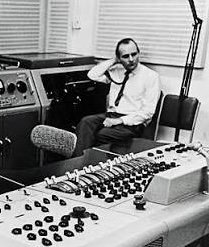
In the 1960s, double-tracking normally meant performing a part twice. John Lennon liked the sound but disliked repeatedly singing a matching second performance.
Abbey Road technical engineer Ken Townsend devised Artificial Double Tracking (ADT): a second tape machine created a controllable delayed copy, with timing varied using frequency-controlled tape speed. The classic ADT separation was typically around 8–12 ms.
Manipulating that timing relationship could also produce phasing/flanging-like effects. Digitally, we can explore the same underlying idea with a buffer and a moving read position.
NOW: ORIGINAL + BUFFER / MOVING READ POSITION → MOVING TIME DIFFERENCE
2. Move the read head
3. Hear the family resemblance
Flanging: very short modulated delay + dry signal creates a moving comb-filter pattern. A harmonically rich sustained source makes the sweep easiest to hear.
4. Why does moving delay change pitch?
The gap shrinks; stored audio is traversed relatively faster → pitch tends upward.
The gap grows; stored audio is traversed relatively slower → pitch tends downward.
Small timing/pitch variation creates movement and thickness.
5. Related, but not identical
Very short modulated delay, mixed with dry; moving comb filtering, often feedback.
Somewhat longer short delays with gentle modulation; thickness and multiple-performer character.
A delayed duplicate with restrained timing variation, designed to evoke a second performance.
These regions overlap: the names describe characteristic uses, not hard mathematical boundaries.
6. The comb filter hiding inside the flanger
Dry audio and its short delayed copy reinforce at some frequencies and cancel at others, producing peaks and notches. Move the delay and the comb moves.
Flanging and phasing sound related because both create moving peaks and notches when a processed signal is combined with the original. But they create those cancellations differently.
Uses a very short modulated delay.
DRY + DELAYED SIGNAL
→ Regularly spaced comb-filter peaks and notches
Uses one or more all-pass filters to shift phase by different amounts at different frequencies.
DRY + PHASE-SHIFTED SIGNAL
→ Frequency-dependent cancellation peaks and notches
So they are close relatives, but not the same process:
Flanging moves a time delay. Phasing moves a frequency-dependent phase relationship. We will come back to phasers when we cover all-pass filters.
7. One tiny change
LFO → CHANGE DELAY TIME ↑