Foundations of Synthesis
Before we explore envelopes, LFOs and broader modulation systems, three foundational approaches explain much of classic synthesis: additive, subtractive and FM.
Additive synthesis — build the spectrum
Additive Principle: construct a complex spectrum by summing simple sinusoidal components.
The conceptual foundation comes from Joseph Fourier's early nineteenth-century work on representing periodic functions as sums of sinusoidal components. Fourier analysis takes a complex waveform apart; additive synthesis runs the idea in the opposite direction and builds a waveform from components.
Additive synthesis offers very precise control because every partial can have its own frequency, amplitude and phase. The trade-off is practical complexity: realistic or evolving sounds may require many independently controlled oscillators/partials. Digital computation made large additive systems much more practical than they were in early hardware.
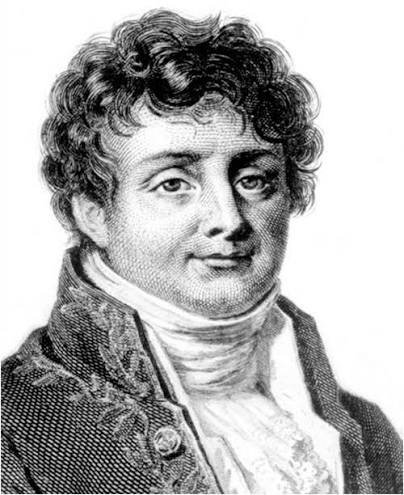 Fourier and the idea of decomposing complex periodic signals into sinusoidal components.
Subtractive synthesis — start rich, then carve
Subtractive Principle: start with a harmonically rich waveform and remove or reduce spectral components with a filter.
This became one of the dominant architectures of analogue synthesis because it is both efficient and intuitive: a sawtooth or square wave already contains many harmonics, so one oscillator can provide rich material that a filter then shapes.
Compared with controlling dozens of individual partials, subtractive synthesis can achieve useful timbral change with relatively few controls: oscillator shape, cutoff, resonance and envelope modulation. That economy helped make it central to classic analogue instruments and remains one of the most familiar synthesis methods today.
If we progressively low-pass (filter) a square wave, remove the 7th, 5th, 3rd… and so on, eventually the fundamental dominates, and the wave becomes increasingly sine-like.
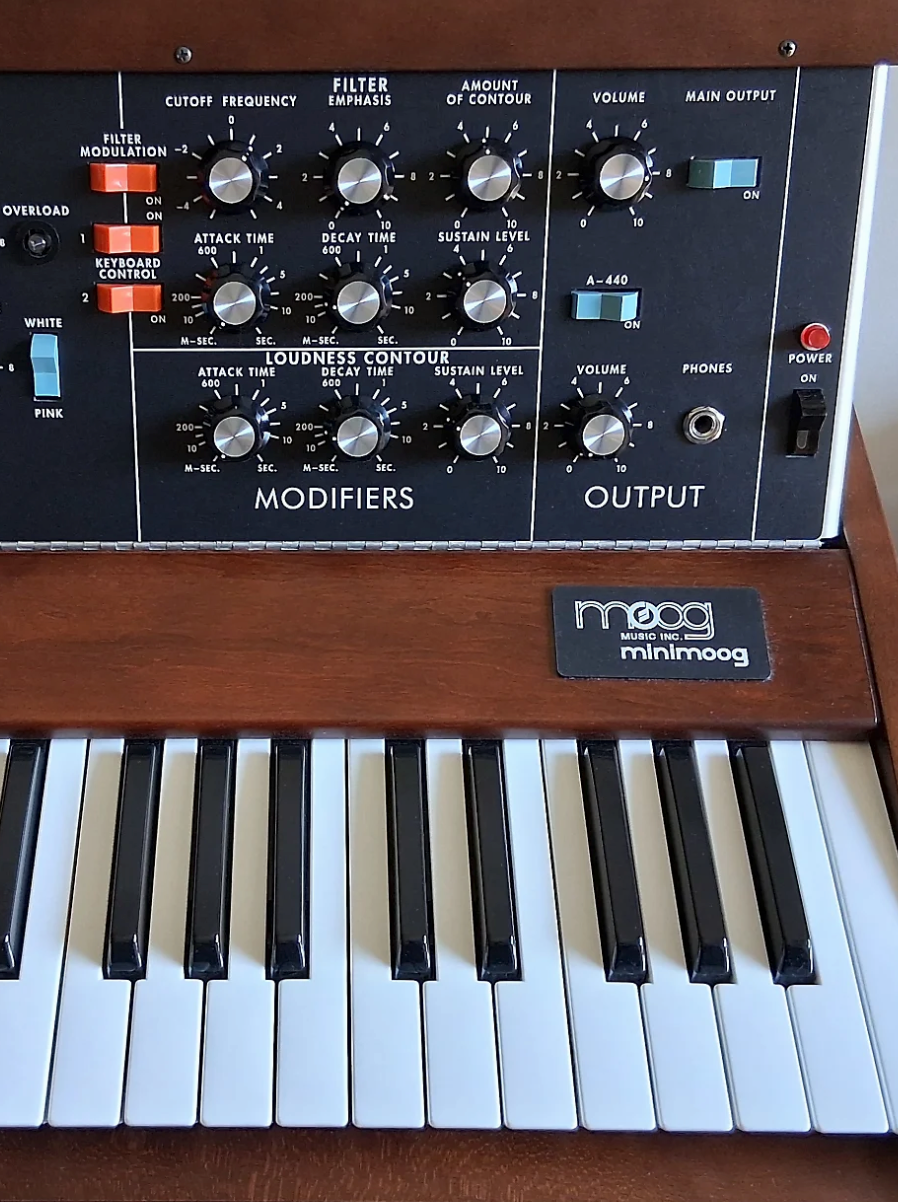
Minimoog Model D — Classic subtractive architecture: oscillators are mixed and shaped by a resonant low-pass filter.
FM synthesis — generate complexity through interaction
FM Principle: use one oscillator to rapidly modulate another oscillator's frequency/phase, creating new sidebands.
John Chowning developed the musical use of frequency modulation synthesis at Stanford in the late 1960s and early 1970s. Yamaha later licensed the technique and turned it into commercially successful instruments, most famously the DX series.
FM became especially prominent through the 1980s and into the 1990s: electric pianos, bells, metallic percussion, basses and sharply articulated digital timbres became part of the sound of the period.
Its great advantage is spectral complexity from relatively few oscillators. A small operator network can create results that would require many separately controlled partials in a purely additive system.
The catch is programmability. Ratio, index, envelopes, operator levels, feedback and routing algorithms interact strongly, so small parameter changes can produce large spectral changes. FM can therefore be computationally economical while being conceptually difficult to programme by ear — one reason factory presets became so important in the DX era.
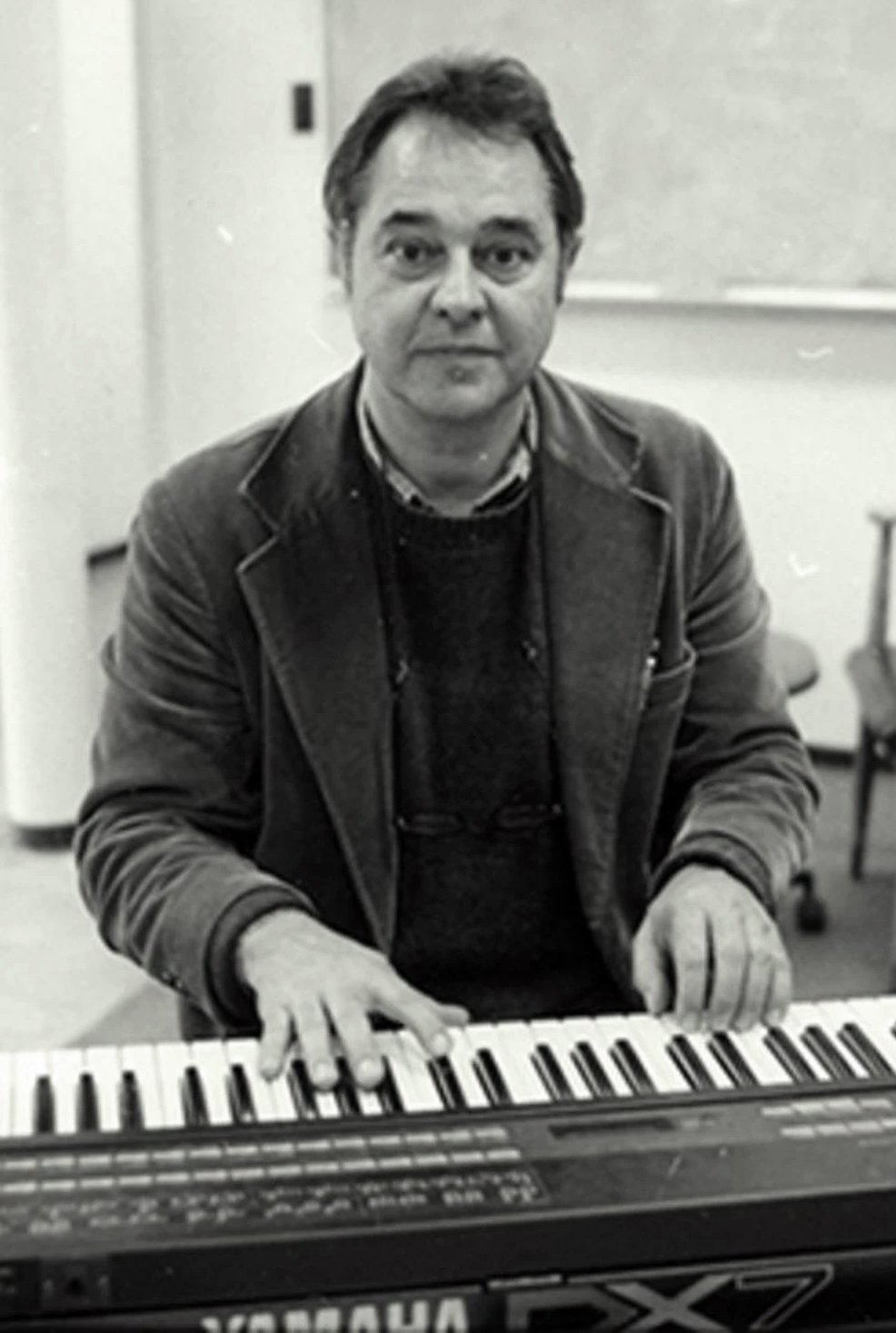
Stanford-era John Chowning with a Yamaha DX7.
Oscilloscope (Time Domain)
Spectrum Analyzer (Frequency Domain)
Summary Comparison
| Method | Starting Material | Primary Operation | Strengths |
|---|---|---|---|
| Additive | Pure Sine Waves | Summing independent harmonics | Precise control over individual partials; powerful for organ-like, evolving and resynthesised spectra, but can require many oscillators. |
| Subtractive | Rich Waveform (Saw/Square) | Filtering out unwanted frequencies | Efficient, intuitive and easy to shape; central to classic analogue synthesis and still extremely common. |
| FM | Simple Sine Oscillators | Frequency modulation creating sidebands | Large spectral complexity from few operators; excellent for bells, electric-piano-like tones, metallic percussion, basses and inharmonic sounds, but harder to programme. |
Other approaches such as wavetable, granular, sampling, physical modelling and waveshaping will be introduced later as extensions beyond these foundations.