Wavetable Synthesis — A Tiny Buffer Becomes an Oscillator
A sampler usually reads a longer recording. A wavetable oscillator repeatedly reads a very short stored waveform. Loop that tiny buffer fast enough and it becomes a pitched oscillator.
1. One cycle in memory
Choose a waveform or draw your own. The dots are the stored table values; the blue read head repeatedly scans from the beginning of the table back to the beginning.
Drag directly on the table to draw a custom single-cycle waveform.
2. The buffer is tiny — but it repeats
Longer buffer
Usually read as an event
May use start/end/loops
Longer buffer
Many tiny windows
Many independent read positions
Tiny cyclic buffer
Repeated continuously
Acts like an oscillator
3. More than one table: move through timbre
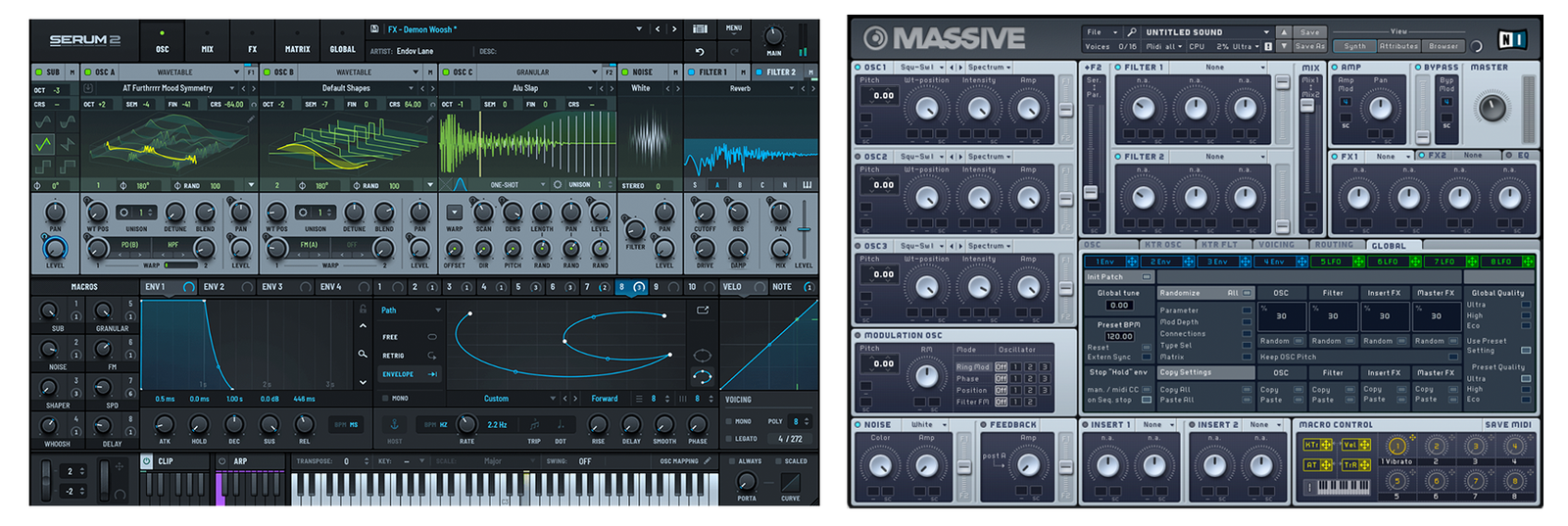
Modern wavetable synths commonly store a sequence of related single-cycle waveforms. The wavetable position chooses where we are between them.
Here the table moves through four frames: sine → triangle → saw → complex. Intermediate positions are interpolated.
4. Wavetable position becomes a modulation destination
Once position is a controllable number, everything from the synthesis chapter applies again. An LFO can move through the table slowly; an envelope can sweep it once; velocity or another controller could select a different timbral region.
5. And all our synth architecture still applies
The wavetable is only the sound source. After it, we can use everything we already learned.
Exactly the same is true for the sampler and granular engine:
6. Sampling chapter summary
Store recorded samples.
Change read speed to change pitch.
Estimate values between stored positions.
Rearrange/window material to separate time from pitch.
Many tiny independently controlled reads.
Repeat tiny waveform buffers as oscillators.